

Charge lag can quietly disrupt your revenue cycle long before a claim reaches the payer. In Athenahealth, open encounters, incomplete documentation, delayed provider sign-offs, and unresolved billing tasks can prevent charges from moving forward, leaving otherwise billable services stuck in the workflow.
As these Athenahealth unbilled encounters accumulate, practices may experience slower claim submission, increased administrative follow-up, cash flow delays, and a greater risk of revenue leakage. Reducing Athenahealth charge lag therefore requires more than asking providers to close charts faster.
It requires a structured encounter closeout workflow that identifies bottlenecks, assigns clear ownership, resolves exceptions promptly, and confirms that completed encounters successfully progress into billing.
What Is Charge Lag in Athenahealth?
Athenahealth charge lag refers to the time between the date a patient receives a service and the point when the associated charge enters the billing process. The longer this gap becomes, the longer a practice may have to wait to create, submit, and ultimately receive payment on a claim.
Charge lag often begins before the billing team can take meaningful action. A provider may still need to complete documentation, add a diagnosis, review charges, respond to a coding question, or sign and close the encounter. Athenahealth notes that a medical claim cannot be submitted until the encounter is closed, making timely chart completion an important part of revenue cycle performance.
A simplified workflow looks like this:
Patient Visit → Clinical Documentation → Encounter Closeout → Charge Entry → Claim Creation → Claim Submission → Reimbursement
When one step stalls, everything downstream can be delayed.
Why Charge Lag Matters to Your Cash Flow
A few delayed encounters may seem insignificant. Across hundreds or thousands of monthly visits, however, small delays can turn into a substantial billing backlog.
Excessive charge lag can contribute to:
- Slower claim creation and submission
- Delayed reimbursement
- Increased administrative follow-up
- Inaccurate month-end revenue visibility
- Greater risk of missing billable services
- Increased exposure to payer timely-filing limits
- More work for providers, coders, and billing teams
- Higher risk of revenue leakage
The objective should not simply be to push charges through faster. Practices need a process that balances speed, documentation completeness, coding accuracy, and claim quality.
How Open and Unbilled Encounters Create Revenue Leakage in Athenahealth
One of the first places to investigate when charge lag begins increasing is the open-encounter backlog.
An encounter can represent care that has already been delivered while still requiring additional work before the revenue cycle can progress. When these encounters remain unresolved, the corresponding charges may not reach claim creation as quickly as expected.
This is where Athenahealth unbilled encounters can become an important revenue-cycle concern.
What Causes Unbilled or Open Encounters?
There isn’t always one underlying cause. An encounter may remain open because of:
- Incomplete clinical documentation
- Missing provider signatures
- Diagnosis or procedure information requiring review
- Coding questions awaiting clarification
- Required co-signatures
- Incomplete billing information
- Documentation needed by the coding team
- Unresolved workflow exceptions
- Unclear responsibility between clinical and billing teams
- Providers carrying unfinished charts from one day to the next
How Open Encounters Can Lead to Revenue Leakage
Consider the following chain:
Unclosed Encounter → Delayed Charge → Delayed Claim → Delayed Payment → Increased Revenue Risk
Not every open encounter represents permanently lost revenue. Some simply represent delayed revenue. However, the longer unresolved encounters remain unnoticed, the greater the risk of missed charges, aging work queues, timely-filing problems, and revenue that requires significant manual effort to recover.
That is why reducing revenue leakage in Athenahealth should include controls at the encounter level, not only denial management after claims have already been submitted.
How to Identify Athenahealth Encounters Holding Up Billing
Managing open encounters effectively starts with visibility. A raw list of unfinished encounters is useful, but it doesn’t tell your team which problems need immediate attention.
Instead, organize your backlog so that patterns become visible.
Start With Encounter Aging
Segment open encounters according to how long they have remained unresolved.
For example:
| Encounter Age | Suggested Action |
| Same day | Normal workflow |
| 1–2 days | Monitor |
| 3–5 days | Follow up with owner |
| 6–10 days | Escalate |
| 10+ days | High-priority investigation |
These ranges are examples rather than Athenahealth-mandated thresholds. Your organization should establish targets based on specialty, staffing, documentation complexity, payer requirements, and internal policies.
The important principle is aging visibility. A 10-day-old unresolved encounter should not receive the same attention as one created a few hours ago.
Segment Open Encounters by Provider, Location, and Department
Next, look beyond total volume.
Ask:
Which providers account for most aging encounters? Which departments consistently have longer closeout times? Are certain appointment types causing problems? Does one location have significantly more open encounters than another?
This analysis can reveal whether you have an organization-wide problem or a concentrated workflow issue.
Athenahealth’s Same Day Encounter Close Rate measures the percentage of encounters fully documented and closed on the day of the patient visit. Athenahealth also uses this metric to help identify documentation bottlenecks and clinicians who may benefit from workflow improvements or additional support.
Separate Clinical Delays From Billing Delays
This distinction is critical.
Clinical delays can include:
- Unfinished documentation
- Missing diagnosis information
- Unsigned encounters
- Missing co-signatures
- Provider clarification
Billing or operational delays may include:
- Coding review
- Charge-entry exceptions
- Billing information requiring correction
- Workflow routing problems
- Documentation requests from coding
- Claims waiting for required information
Without this separation, billing teams may repeatedly chase providers for issues providers don’t own, or clinical teams may assume billing is handling an encounter that still requires clinical action.
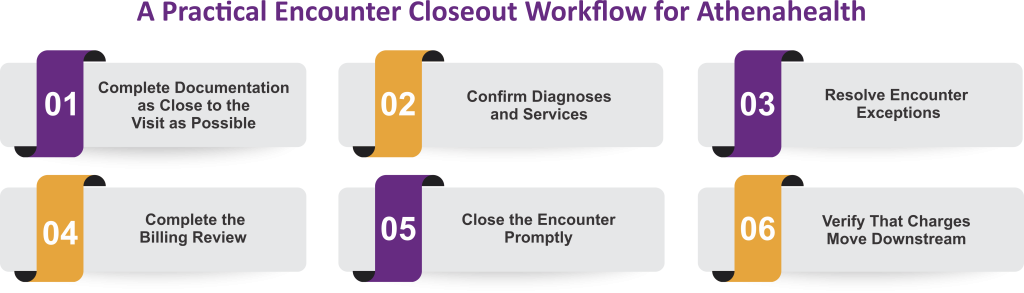
A Practical Encounter Closeout Workflow for Athenahealth
An effective encounter closeout workflow creates a predictable path from patient care to billing. Each step should have an owner, expected completion time, and escalation process.
Step 1: Complete Documentation as Close to the Visit as Possible
The fastest way to prevent a documentation backlog is to avoid creating one.
Encourage providers to complete charts during or shortly after the patient visit whenever clinically appropriate. Standardized templates, macros, documentation accelerators, and other supported documentation tools can reduce repetitive work.
Athenahealth recommends monitoring chart completion, using documentation accelerators, training clinicians on encounter efficiency, and using benchmarking data to improve workflows.
Step 2: Confirm Diagnoses and Services
Before closing an encounter, confirm that documentation accurately reflects the services delivered and contains the information necessary for coding and billing.
Speed should never come at the expense of accuracy.
A rapidly closed encounter with missing or unsupported information may simply shift the problem downstream, creating coding queries, claim holds, rejections, or denials.
Step 3: Resolve Encounter Exceptions
Create clear categories for incomplete encounters, such as:
- Provider documentation required
- Signature required
- Coding clarification required
- Missing diagnosis
- Billing review required
- Additional documentation requested
Every category should have a designated owner.
If no one knows who owns an exception, it can remain unresolved indefinitely.
Step 4: Complete the Billing Review
Once the clinical components are complete, verify that required billing information has been reviewed.
This is particularly important when automation is involved. Athenahealth’s Automatic Claim Creation feature, for example, creates claims in the background when required criteria are satisfied. Athenahealth currently lists appointment checkout, encounter sign-off and closure, and review/completion of the Billing tab among those criteria.
Step 5: Close the Encounter Promptly
Encounter closeout should be part of the normal visit lifecycle, not a cleanup activity saved for Friday afternoon or month-end.
Practices should establish realistic expectations for when encounters need to be completed while accounting for complex cases that legitimately require additional documentation.
Step 6: Verify That Charges Move Downstream
Closing the encounter should not be the end of your revenue-control process.
Establish reconciliation procedures to confirm that expected billable activity actually moves into the appropriate billing and claim workflow.
This creates an important control:
Completed Visit → Closed Encounter → Expected Charge → Claim
When the chain breaks, your team knows where to investigate.
Managing Open Encounters Without Overloading Providers
Effective management of open encounters isn’t about sending clinicians increasingly long spreadsheets or reminder emails.
The objective is to send the right issue to the right person at the right time.
Establish Clear Ownership
A responsibility matrix can make the process significantly easier:
| Issue | Potential Owner |
| Incomplete clinical note | Provider |
| Missing signature | Provider |
| Coding clarification | Coder + provider |
| Billing review | Billing team |
| Aging encounter escalation | RCM lead/practice manager |
| Recurring workflow issue | RCM lead/Athenahealth administrator |
Actual responsibilities should be adapted to your organization’s staffing model and Athenahealth configuration.
Review Exceptions Daily
Waiting until month-end allows small problems to become large backlogs.
A more proactive structure might include:
Daily: Review new exceptions and aging encounters.
Twice weekly: Follow up on unresolved provider/coding items.
Weekly: Review trends by provider, department, and reason.
Monthly: Conduct root-cause analysis and evaluate KPIs.
This approach transforms encounter management from periodic cleanup into continuous revenue-cycle control.
Escalate Based on Age and Risk
Not every encounter requires an urgent message to the provider.
Build escalation rules based on encounter age, underlying issue, financial significance, and filing deadlines.
The goal is to prevent your staff from developing “alert fatigue” while ensuring genuinely problematic encounters receive attention.
How to Reduce Athenahealth Charge Lag With Workflow Optimization
Once you’ve identified why charges are delayed, focus on removing repetitive bottlenecks.
Consider Automatic Claim Creation Where Appropriate
Automation can help reduce manual steps when encounters meet the appropriate criteria.
Athenahealth reports that athenaOne clients using Auto Claim Create from January through June 2024 had a median charge entry lag of 2.17 days compared with 6.7 days for clients not enrolled, a 66% difference.
More recently, Athenahealth published a case involving Barrington Internal Medicine in which charge-entry lag reportedly declined from around 60 days to approximately 14 days after Automatic Claim Creation was enabled. This is an individual practice example, not a guaranteed result for every organization.
Automation should therefore be evaluated according to your workflows, specialties, coding requirements, and Athenahealth configuration rather than viewed as a universal solution.
Standardize Documentation Workflows
If five providers handle the same appointment type five completely different ways, closeout performance becomes harder to manage.
Where appropriate, standardize:
- Specialty-specific templates
- Documentation requirements
- Encounter completion steps
- Coding-query workflows
- Billing review procedures
- Closeout responsibilities
- Escalation paths
Standardization also makes training new staff easier and helps reveal exceptions more quickly.
Reduce Unnecessary Handoffs
Every handoff creates an opportunity for work to stop.
Consider an encounter that moves from:
Provider → Medical Assistant → Coder → Provider → Billing Staff → Manager
If ownership isn’t visible at every transition, the encounter can spend more time waiting than being worked.
Map your existing process and ask:
Which handoffs add value, and which exist only because “that’s how we’ve always done it”?
Removing even one unnecessary handoff across thousands of encounters can reduce administrative workload substantially.
Build a Daily Athenahealth Encounter Closeout Process
A sustainable process should identify exceptions before they become a backlog.
A practical daily workflow can include:
- Review recently completed patient visits.
- Identify encounters that remain open.
- Categorize each open encounter by reason.
- Assign the exception to the appropriate owner.
- Prioritize encounters based on age and risk.
- Resolve documentation and coding questions.
- Confirm required encounter closeout activities are complete.
- Verify expected charges move downstream.
- Escalate unresolved aging encounters.
- Document recurring causes for future process improvement.
This workflow makes the process manageable because your staff is working primarily on exceptions, rather than manually investigating every encounter.
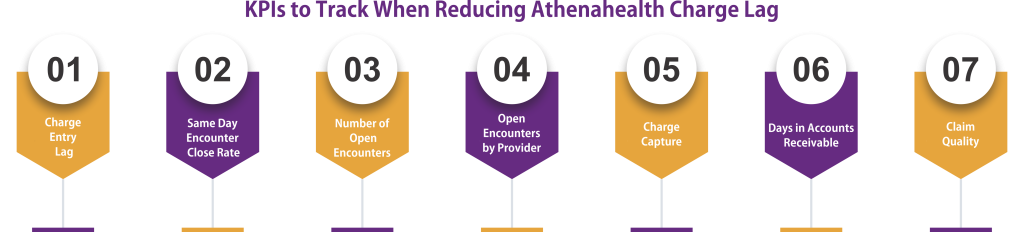
KPIs to Track When Reducing Athenahealth Charge Lag
You can’t sustainably improve charge lag without measuring what happens before and after your intervention.
1. Charge Entry Lag
Measure how long it takes services to move from the date of service into charge entry.
Track both averages and medians where possible. Averages can be distorted by a relatively small number of extremely old encounters.
2. Same Day Encounter Close Rate
Athenahealth defines Same Day Encounter Close Rate as the percentage of encounters fully documented and closed on the same day as the patient visit.
Tracking this by provider can help identify where additional training, documentation optimization, or workflow support may be beneficial.
3. Number of Open Encounters
Don’t look at the total alone.
Break it into aging categories:
0–2 days | 3–5 days | 6–10 days | 10+ days
An organization could have fewer open encounters overall while still carrying a serious backlog of old, high-risk encounters.
4. Open Encounters by Provider
Provider-level reporting can reveal concentrated documentation problems.
However, use the metric diagnostically rather than simply as a performance score. Athenahealth itself notes that chart-closure performance can be affected by technology, training, workflow design, and clinical complexity—not merely individual clinician behavior.
5. Charge Capture
Monitor whether services documented and delivered are making it into billing.
Charge capture is especially important for identifying situations where the encounter appears complete operationally but expected revenue is missing.
6. Days in Accounts Receivable
Days in A/R is downstream from encounter closeout, but it provides valuable context for overall revenue-cycle performance.
Do not confuse the two metrics:
Charge lag: How quickly the service becomes a charge.
Days in A/R: How long receivables remain outstanding.
Improving charge lag can accelerate the beginning of the reimbursement process, but payer processing, denials, patient balances, and follow-up can still affect A/R.
7. Claim Quality
Don’t optimize speed in isolation.
Monitor rejection, denial, coding, and claim-quality indicators alongside charge lag. A workflow that creates claims faster but produces more errors simply moves work from the front of the revenue cycle to the back.
How to Prevent Revenue Leakage From Unbilled Encounters
Eliminating today’s backlog is useful. Preventing tomorrow’s backlog is more valuable.
Reconcile Visits Against Charges
Establish a process for comparing completed patient visits with expected charges.
This can help identify situations where:
- A visit occurred, but the encounter remains open.
- The encounter closed but expected billing activity is missing.
- Documentation is incomplete.
- Coding requires clarification.
- An operational exception prevented downstream processing.
This type of reconciliation acts as an early-warning system for potential revenue leakage in Athenahealth.
Audit Aging Open Encounters
Prioritize the oldest encounters and determine why they haven’t progressed.
Don’t stop after resolving them. Record the root cause.
For example, if 70% of your oldest encounters belong to one appointment type, you probably don’t have 70 individual problems; you may have one recurring workflow problem.
Identify Repeat Patterns
Look for trends involving:
- Particular providers
- Appointment types
- Departments
- Locations
- Procedures
- Documentation requirements
- Coding queries
- Workflow routing
Patterns turn a backlog into actionable information.
Fix the Cause, Not Just the Queue
Your team could spend days closing hundreds of old encounters and still find itself in exactly the same position next month.
Closing 500 aging encounters fixes today’s backlog. Fixing the process that caused those encounters to remain open can help prevent the next 500.
That is the difference between backlog management and genuine revenue-cycle optimization.
A 30-Day Plan to Reduce Athenahealth Charge Lag
You don’t need to redesign the entire revenue cycle overnight. A focused 30-day improvement cycle can provide a practical starting point.
Week 1: Establish Your Baseline
Measure:
- Current charge lag
- Total open encounters
- Open encounters by age
- Open encounters by provider
- Same-day encounter close rate
- Common unresolved encounter reasons
Your baseline gives you something objective to improve.
Week 2: Identify Root Causes
Categorize your unresolved encounters.
Determine whether delays primarily involve:
Documentation, provider sign-off, coding, billing review, workflow routing, staffing, training, or another operational issue.
Prioritize the causes responsible for the largest volume or greatest financial risk.
Week 3: Address Workflow Bottlenecks
Implement targeted improvements.
These might include:
- New closeout expectations
- Clearer ownership
- Provider training
- Standardized templates
- Better coding-query routing
- Daily exception review
- Escalation rules
- Appropriate automation
Avoid trying to change ten processes simultaneously. Fix the largest bottlenecks first.
Week 4: Measure the Impact
Compare your new results with the Week 1 baseline.
Review changes in:
| KPI | Baseline | Day 30 |
| Median charge lag | ___ | ___ |
| Total open encounters | ___ | ___ |
| Encounters 10+ days old | ___ | ___ |
| Same-day close rate | ___ | ___ |
| Unresolved coding queries | ___ | ___ |
| Expected charges captured | ___ | ___ |
If performance improves, standardize the process if it doesn’t, return to the underlying data and investigate where the workflow is still breaking.
When Athenahealth RCM Support Can Help
Managing charge lag becomes increasingly difficult when billing staff is simultaneously handling claim submission, coding follow-ups, payment posting, denials, aging A/R, and daily encounter exceptions. In these situations, specialized RCM support can help practices establish consistent workflows, address unresolved billing work, and improve visibility across the revenue cycle.
If your practice needs additional support with billing operations, charge capture, claims, denials, and revenue-cycle performance, explore our Athenahealth RCM Services to see how dedicated RCM expertise can support your Athenahealth workflow.
Conclusion
Reducing Athenahealth charge lag isn’t simply about asking providers to finish charts faster. Sustainable improvement requires visibility into open encounters, clear ownership of exceptions, timely documentation, effective coding and billing workflows, and consistent reconciliation between completed visits and expected charges.
Practices that monitor encounter aging daily can identify problems while they’re still manageable rather than discovering a large backlog at month-end. More importantly, analyzing why encounters remain open allows the organization to address the underlying workflow problems that repeatedly delay billing.