

Every delayed claim represents delayed revenue. In athenahealth, hold buckets are designed to flag claims that require attention before they can move through the reimbursement process. While this feature helps prevent costly billing mistakes, claims that remain in hold buckets for too long can disrupt cash flow, increase accounts receivable, and create unnecessary administrative work.
Why claims get stuck, how to identify the underlying issues, and what steps to take for resolution is essential for maintaining a healthy revenue cycle. In this article, we’ll explore the most common causes of hold bucket delays, their impact on practice performance, and the strategies that help billing teams resolve and prevent these issues efficiently.
What Are Hold Buckets in athenahealth?
Hold buckets in Athenahealth are designated work queues where claims are temporarily placed when they require additional review, correction, or supporting information before submission or reimbursement. These buckets act as a safeguard within the revenue cycle management process, helping billing teams identify and address issues that could otherwise lead to claim rejections or denials.
Unlike denied claims, which have already been processed and rejected by a payer, claims in hold buckets are stopped before they reach the final stage of payment processing. This allows organizations to resolve errors proactively and improve their clean claim rates. Hold buckets can contain claims affected by eligibility issues, coding discrepancies, missing documentation, authorization problems, and other billing-related concerns.
By regularly monitoring hold buckets, healthcare organizations can reduce reimbursement delays, improve operational efficiency, and maintain a steady cash flow.
Why Do Claims Get Stuck in Athenahealth Hold Buckets?
Claims can become stuck in Athenahealth hold buckets for a variety of reasons. In most cases, the issue originates from incomplete information, billing errors, or payer-specific requirements that prevent the claim from advancing through the reimbursement process.
Missing or Incomplete Patient Information
Patient demographic errors are among the most common causes of claim holds. Incorrect names, dates of birth, addresses, or insurance subscriber details can trigger validation issues and prevent claim submission.
Common examples include:
- Misspelled patient names
- Incorrect member IDs
- Missing subscriber information
- Outdated insurance records
Even minor inaccuracies can create significant payment delays if they are not identified and corrected promptly.
Eligibility Verification Issues
Insurance eligibility problems frequently place claims into hold buckets. When coverage cannot be verified or patient benefits have changed, athenahealth may flag the claim for further review.
Typical eligibility-related issues include:
- Inactive insurance coverage
- Expired policies
- Coordination of benefits conflicts
- Incorrect payer selection
Performing eligibility verification before patient visits can significantly reduce these hold scenarios.
Coding and Documentation Errors
Accurate coding is essential for claim acceptance. If diagnosis codes, procedure codes, or modifiers do not align with payer requirements, claims may be held until corrections are made.
Examples include:
- Incorrect CPT codes
- ICD-10 coding mismatches
- Missing modifiers
- Incomplete clinical documentation
- Lack of medical necessity support
These issues often require collaboration between providers, coders, and billing staff to resolve efficiently.
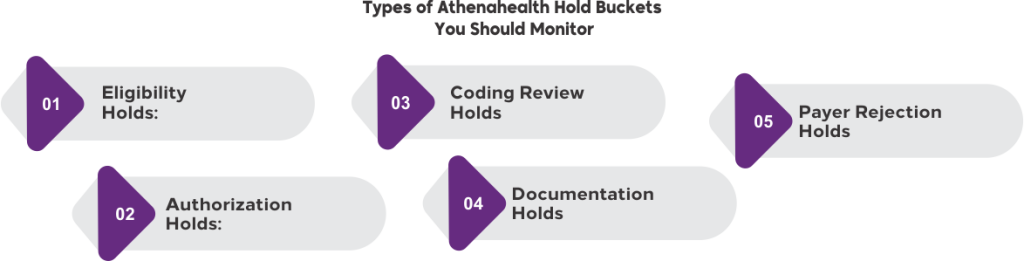
Types of Athenahealth Hold Buckets You Should Monitor
Not all hold buckets carry the same level of urgency. Understanding the different categories helps billing teams prioritize work based on financial impact and reimbursement risk.
Eligibility Holds:
Eligibility holds occur when insurance coverage cannot be verified or when policy information appears invalid. These claims should be addressed quickly because unresolved eligibility issues can eventually lead to denials.
Authorization Holds:
Many procedures require prior authorization from the payer. Claims lacking authorization details or containing expired authorization numbers are commonly routed to authorization hold buckets.
Coding Review Holds:
Coding review holds are triggered when Athenahealth identifies potential coding inconsistencies. These claims often require review by certified coders before they can proceed.
Documentation Holds:
Missing or incomplete medical records can place claims into documentation holds. Providers may need to finalize encounter notes or supply additional supporting information before billing can continue.
Payer Rejection Holds:
Claims that fail payer-specific edits or clearinghouse validations may be placed into rejection-related hold buckets. These issues generally require correction and resubmission.
Organizations that regularly prioritize high-value claims within these hold categories can minimize revenue disruptions and improve reimbursement timelines.
How to Identify Claims Stuck in Hold Buckets?
Identifying claims that remain in hold buckets for extended periods is critical for preventing revenue leakage. Without routine monitoring, unresolved claims can age significantly and become increasingly difficult to collect.
Review Work Queues Daily
Billing teams should review hold bucket work queues every day to identify newly held claims and address issues before they escalate. Daily reviews help prevent backlogs and improve claim turnaround times.
Monitor Claim Aging
Aging reports provide valuable insight into how long claims have remained unresolved. Claims that remain in hold status beyond established benchmarks should be prioritized immediately.
Common aging categories include:
- 0–15 days
- 16–30 days
- 31–60 days
- 61–90 days
- Over 90 days
The older a claim becomes, the greater the risk of delayed or lost reimbursement.
Use Revenue-at-Risk Reporting
Advanced reporting allows organizations to identify the total dollar value associated with hold bucket claims. This helps management focus resources on the claims that have the greatest financial impact.
Tracking hold volume, aging trends, and revenue exposure creates greater visibility and supports faster resolution efforts.
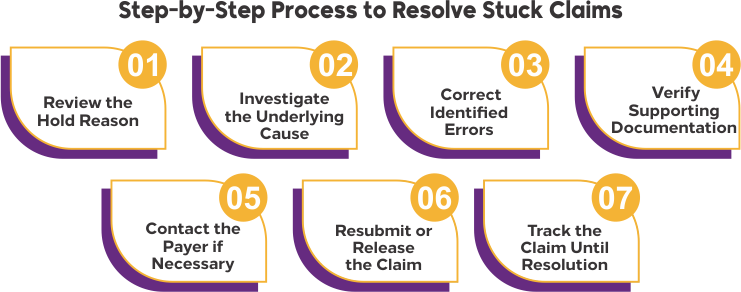
Step-by-Step Process to Resolve Stuck Claims
A structured resolution process helps organizations clear hold buckets more efficiently and reduce recurring billing issues.
Step 1: Review the Hold Reason
Start by identifying the specific reason the claim was placed on hold. Understanding the root issue prevents unnecessary rework and speeds up resolution.
Step 2: Investigate the Underlying Cause
Determine whether the problem is related to eligibility, coding, authorization, documentation, or payer requirements. Addressing the actual cause is essential for preventing repeat holds.
Step 3: Correct Identified Errors
Update patient demographics, insurance information, diagnosis codes, procedure codes, modifiers, or authorization details as needed.
Step 4: Verify Supporting Documentation
Ensure all clinical notes, treatment records, and medical necessity documentation are complete and properly attached when required.
Step 5: Contact the Payer if Necessary
For payer-specific questions, contacting the insurance company can clarify requirements and prevent further processing delays.
Step 6: Resubmit or Release the Claim
Once corrections have been made, move the claim back into the billing workflow so it can continue through the reimbursement process.
Step 7: Track the Claim Until Resolution
Resolution does not end with resubmission. Monitor the claim through payment posting to confirm that the issue has been fully resolved and reimbursement has been received.
Following a consistent workflow helps billing teams reduce claim aging, improve productivity, and maintain healthier revenue cycle performance.
How Hold Buckets Impact Revenue Cycle Performance?
Hold buckets may appear to be a routine operational feature, but when claims remain unresolved for extended periods, they can significantly affect a healthcare organization’s financial performance. Every claim sitting in a hold bucket represents revenue that has not yet been collected.
Increased Days in Accounts Receivable:
Claims that remain on hold contribute directly to higher accounts receivable (A/R) days. The longer claims are delayed, the longer providers must wait for reimbursement, which can strain cash flow and reduce financial predictability.
Delayed Cash Flow:
Healthcare organizations depend on timely reimbursements to cover operational expenses, payroll, technology investments, and patient care initiatives. Large volumes of held claims can create substantial cash flow disruptions.
Higher Denial Rates:
Claims that are not corrected properly while in hold status may eventually be submitted with unresolved issues, increasing the likelihood of payer denials. Denials typically require additional work and resources to appeal or resubmit.
Reduced Staff Productivity:
Billing teams often spend considerable time investigating aging claims, correcting errors, and communicating with payers. As hold bucket volumes increase, staff productivity can decline due to repetitive manual work.
Compliance and Audit Risks:
Incomplete documentation, coding inaccuracies, and authorization deficiencies can create compliance concerns if not addressed appropriately. Regular monitoring of hold buckets helps organizations maintain billing accuracy and reduce audit exposure.
When left unmanaged, hold buckets can become a hidden source of revenue leakage. Proactive oversight helps organizations improve reimbursement timelines and strengthen overall revenue cycle performance.
Common Athenahealth Hold Bucket Scenarios and Their Solutions
Understanding common hold bucket scenarios can help billing teams resolve issues faster and prevent similar problems from occurring in the future.
| Hold Scenario | Common Cause | Recommended Solution |
| Eligibility Hold | Inactive insurance coverage | Verify benefits and update insurance information |
| Authorization Hold | Missing or expired authorization | Obtain valid authorization and update claim |
| Coding Hold | CPT and ICD-10 mismatch | Review coding and correct inconsistencies |
| Documentation Hold | Missing clinical notes | Complete and attach required documentation |
| Payer Rejection Hold | Failed payer edits | Correct errors and resubmit claim |
| Demographic Hold | Inaccurate patient information | Verify and update patient records |
| Duplicate Claim Hold | Potential duplicate submission | Review claim history before resubmission |
| COB Hold | Coordination of benefits issue | Confirm primary and secondary payer information |
Organizations that identify recurring patterns within these scenarios can address root causes rather than repeatedly correcting the same errors.
Advanced Troubleshooting for Persistent Hold Bucket Claims
Some claims continue to reappear in hold buckets despite multiple correction attempts. These situations often require deeper investigation and a more strategic resolution process.
Claims That Repeatedly Return to Hold Status: When the same claim returns to a hold bucket multiple times, there is often an underlying workflow issue that has not been fully addressed. Review all previous corrections, payer communications, and claim notes to identify recurring patterns.
Coordination of Benefits Errors: Patients with multiple insurance policies can create complex billing situations. Incorrect payer sequencing or outdated coordination of benefits information often results in recurring holds and reimbursement delays.
Payer-Specific Billing Requirements: Many payers maintain unique billing requirements that differ from standard claim submission rules. Claims may repeatedly fail edits if payer-specific requirements are not properly documented and followed.
Duplicate Claim Concerns: Duplicate claim detection systems can place valid claims into hold buckets when multiple submissions appear similar. Reviewing submission history before resubmitting claims can prevent unnecessary delays.
Global Period and Bundling Issues: Claims associated with surgical global periods or bundled services may trigger holds when procedures are billed separately. Reviewing payer guidelines and coding policies can help resolve these issues.
Advanced troubleshooting focuses on identifying the true source of recurring holds rather than simply correcting symptoms.
Best Practices to Prevent Claims From Getting Stuck
Preventing hold bucket issues is far more efficient than resolving them after they occur. A proactive approach involving front-office staff, providers, coders, and billing teams can significantly reduce hold volumes.
Strengthen Front-End Processes
The majority of claim issues begin at patient registration. Accurate data collection helps eliminate many avoidable holds.
Best practices include:
- Verify insurance eligibility before every visit
- Confirm patient demographics regularly
- Collect updated insurance cards
- Validate referral requirements
Improve Clinical Documentation
Providers should ensure documentation supports all billed services and clearly demonstrates medical necessity.
Recommended actions include:
- Complete encounter notes promptly
- Document diagnoses thoroughly
- Include supporting clinical details
- Address documentation deficiencies quickly
Conduct Regular Coding Reviews
Routine coding audits help identify trends that could lead to claim holds.
Key areas to review:
- CPT code accuracy
- ICD-10 specificity
- Modifier usage
- Payer-specific coding requirements
Implement Daily Hold Bucket Reviews
Organizations should establish dedicated workflows for reviewing and resolving hold bucket claims each day rather than allowing claims to accumulate.
Leverage Automation
Automated claim scrubbing, eligibility verification tools, and workflow alerts can identify potential errors before claims enter hold status.
Preventive measures not only reduce hold bucket volume but also improve clean claim rates and accelerate reimbursement.
Key KPIs to Track for Hold Bucket Management
Successful hold bucket management requires continuous measurement. Tracking key performance indicators (KPIs) helps organizations identify inefficiencies, monitor improvements, and reduce reimbursement delays.
Hold Bucket Volume:
This metric measures the total number of claims currently residing in hold buckets. A growing volume may indicate process inefficiencies or staffing challenges.
Claims Aging by Hold Category:
Monitoring how long claims remain in each hold bucket helps identify bottlenecks and prioritize corrective actions.
Clean Claim Rate:
The clean claim rate measures the percentage of claims submitted without requiring corrections. Higher rates generally indicate stronger front-end and billing processes.
First-Pass Resolution Rate:
This KPI tracks how often claims are successfully resolved after a single review. A high first-pass resolution rate reflects effective problem identification and correction.
Denial Rate:
Monitoring denial trends helps organizations determine whether hold bucket issues are contributing to downstream reimbursement problems.
Days in Accounts Receivable:
A/R days provide insight into how quickly organizations convert billed services into collected revenue.
Revenue at Risk:
This metric calculates the total dollar value associated with claims currently in hold buckets. Tracking revenue at risk helps leadership prioritize high-impact claims and allocate resources effectively.
Organizations that consistently monitor these KPIs are better positioned to reduce claim delays, improve operational efficiency, and maximize reimbursement outcomes.
How Athenahealth Features Help Reduce Hold Bucket Claims
Managing hold buckets manually can be time-consuming and resource-intensive. Fortunately, athenahealth provides several tools and workflow capabilities that help organizations identify issues earlier, streamline claim processing, and reduce the number of claims that become stuck.
Automated Claim Scrubbing
Claim scrubbing technology reviews claims for potential errors before submission. By identifying coding inconsistencies, missing information, and payer-specific requirements early, organizations can address issues before claims enter hold status.
Benefits include:
- Fewer submission errors
- Reduced claim rework
- Improved clean claim rates
- Faster reimbursement cycles
Eligibility Verification Capabilities
Insurance eligibility verification helps confirm patient coverage before services are rendered. This reduces eligibility-related hold bucket issues and minimizes claim delays caused by inactive or inaccurate insurance information.
Denial Management Workflows
Integrated denial management tools help billing teams identify recurring trends, prioritize unresolved claims, and address reimbursement challenges more effectively.
These workflows support:
- Faster issue identification
- Improved claim tracking
- Better payer communication
- Reduced denial rates
Reporting and Analytics
Advanced reporting tools provide visibility into hold bucket performance, claim aging, and financial risk. Organizations can use these insights to identify bottlenecks and improve operational efficiency.
Key reporting areas include:
- Hold bucket volume
- Aging claims analysis
- Revenue at risk
- Denial trends
- Staff productivity metrics
Workflow Automation
Automation reduces manual intervention by routing claims to appropriate team members, generating alerts for aging claims, and prioritizing high-value accounts requiring immediate attention.
Organizations that effectively utilize these capabilities often experience fewer claim delays and stronger revenue cycle performance.
Real-World Example: Recovering Revenue From athenahealth Hold Buckets
To understand the impact of effective hold bucket management, consider the following example.
The Challenge
A multi-provider medical practice noticed a growing backlog of claims in various hold buckets. More than 300 claims had remained unresolved for over 45 days, creating significant cash flow concerns.
Upon review, leadership discovered that a large percentage of held claims were associated with insurance eligibility issues and incomplete patient registration information.
The Investigation
The billing team conducted a detailed analysis of aging claims and identified several recurring problems:
- Outdated insurance information
- Failure to verify eligibility before appointments
- Missing subscriber details
- Delayed claim review processes
These issues were causing claims to cycle repeatedly through hold buckets without resolution.
The Solution
The organization implemented several corrective measures:
- Introduced real-time eligibility verification
- Established daily hold bucket reviews
- Created escalation procedures for aging claims
- Improved front-desk registration workflows
- Conducted staff training on insurance data collection
The Results
Within a few months, the practice achieved measurable improvements:
- Significant reduction in hold bucket volume
- Faster claim resolution times
- Improved clean claim rates
- Lower denial rates
- Stronger monthly cash flow
This example demonstrates how identifying root causes and implementing proactive workflows can transform hold bucket management and improve financial performance.
Final Thoughts
Claims getting stuck in Athenahealth hold buckets can create significant financial and operational challenges if not addressed promptly. While hold buckets serve an important role in preventing billing errors and reducing denials, unresolved claims can increase accounts receivable, delay reimbursements, and negatively impact cash flow.
The most successful healthcare organizations treat hold bucket management as an ongoing revenue cycle priority. By understanding the common causes of claim holds, monitoring key performance indicators, implementing preventive workflows, and addressing issues quickly, providers can minimize claim delays and improve reimbursement outcomes.
A proactive approach that combines accurate patient data collection, strong documentation practices, coding accuracy, eligibility verification, and consistent hold bucket monitoring can significantly reduce revenue leakage and help maintain a healthier, more efficient billing operation.