Prior authorizations have become one of the biggest operational bottlenecks in healthcare. Staff spend countless hours navigating payer portals, making repetitive follow-up calls, gathering documentation, and chasing approvals that delay both patient care and reimbursements. The result is growing administrative burnout, rising denial rates, and slower cash flow for providers.
AI is changing that reality. By automating eligibility checks, extracting clinical data, tracking authorization statuses, and even handling payer communications, AI removes the repetitive manual work that drains healthcare teams every day.
Instead of reacting to delays and denials, providers can move toward faster approvals, cleaner claims, and a more efficient revenue cycle without adding more staff.
What Is Prior Authorization in Healthcare?
Prior authorization is a cost-control process used by health insurance companies to determine whether a medical service, treatment, procedure, or prescription is medically necessary before approving payment. Providers must submit clinical documentation, patient information, diagnosis codes, and treatment details to insurers for review before care can move forward.
While insurers designed prior authorization to reduce unnecessary healthcare spending, the process has evolved into a major administrative burden for providers and revenue cycle management (RCM) teams. Today, healthcare staff often spend hours manually collecting records, filling out payer-specific forms, checking eligibility, and following up repeatedly to secure approvals.
Common services that frequently require prior authorization include:
- Advanced imaging procedures like MRIs and CT scans
- Specialty medications and biologics
- Surgical procedures
- Physical therapy services
- Oncology treatments
- Durable medical equipment (DME)
- Behavioral health services
A typical manual prior authorization workflow looks something like this:
- Verify patient insurance eligibility
- Identify payer authorization requirements
- Gather supporting clinical documentation
- Submit forms through payer portals or fax
- Follow up via phone calls or emails
- Correct missing or rejected information
- Wait for final approval or denial
The problem is that every payer has different rules, timelines, and documentation standards. Even a small coding error or missing note can delay approvals for days or weeks. These delays not only impact patient care but also create reimbursement bottlenecks that affect the entire healthcare revenue cycle.
The Real Problem With Manual Prior Authorization
Manual prior authorization is one of the most time-consuming and inefficient processes in healthcare administration. For many organizations, it has become a constant cycle of paperwork, payer follow-ups, and claim delays that drains both productivity and revenue.
Endless Phone Calls and Portal Logins
Healthcare staff often juggle multiple payer portals daily, each with different workflows, credential requirements, and submission rules. When online updates are unavailable, teams are forced to spend valuable hours on phone calls just to check authorization statuses or request missing information.
This constant back-and-forth creates operational slowdowns that prevent staff from focusing on higher-value tasks.
Repetitive Documentation Collection
Manual prior authorization requires teams to repeatedly gather:
- Physician notes
- Lab results
- Imaging reports
- Referral documents
- CPT and ICD codes
- Medical necessity records
Because much of this information already exists inside the EHR, manually extracting and uploading it becomes a repetitive administrative burden that increases the risk of human error.
Staff Burnout and Rising Operational Costs
Prior authorization management demands significant staffing resources. Many healthcare organizations now dedicate entire teams solely to payer communication and authorization follow-ups.
The result?
- Increased labor costs
- Staff frustration
- High turnover rates
- Reduced operational efficiency
As authorization volumes continue to rise, healthcare providers face growing pressure to scale administrative teams just to maintain existing workflows.
Approval Delays Hurt Patients and Revenue
Authorization delays directly impact patient care. Patients may wait days or weeks for critical treatments, imaging studies, or medications while providers chase payer approvals.
At the same time, delayed authorizations slow reimbursements, disrupt scheduling, and increase cash flow uncertainty for healthcare organizations.
Claim Denials Create Revenue Leakage
One of the biggest risks of manual prior authorization is preventable claim denials. Missing documentation, incorrect codes, expired authorizations, or payer-specific submission errors can lead to denied claims that require costly rework and appeals.
Every denied authorization creates additional administrative work, delayed revenue, and increased financial pressure across the revenue cycle.
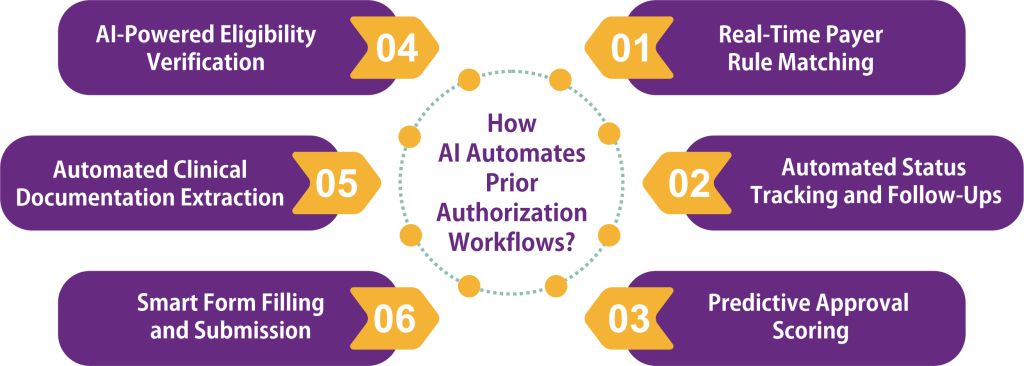
How AI Automates Prior Authorization Workflows?
Artificial intelligence is transforming prior authorization from a reactive, manual process into an intelligent, automated workflow. Instead of relying on staff to manage repetitive administrative tasks, AI-powered systems streamline the entire authorization lifecycle with greater speed, accuracy, and scalability.
1. AI-Powered Eligibility Verification
AI can instantly verify patient insurance coverage, benefits, and authorization requirements in real time. Rather than manually checking payer portals, staff receive immediate insights into:
- Coverage status
- Authorization necessity
- Policy limitations
- Payer-specific rules
This significantly reduces front-end delays and minimizes eligibility-related denials.
2. Automated Clinical Documentation Extraction
Using technologies like Natural Language Processing (NLP) and Optical Character Recognition (OCR), AI can automatically extract relevant clinical information directly from EHRs, physician notes, and medical records.
Instead of manually gathering documents, AI identifies:
- Diagnosis details
- Treatment history
- Medical necessity evidence
- Supporting clinical records
This accelerates submission readiness while reducing human error.
3. Smart Form Filling and Submission
AI systems can automatically populate payer-specific authorization forms using patient and clinical data already stored within healthcare systems. This eliminates repetitive data entry and ensures submissions meet payer formatting requirements.
Some advanced platforms can even submit requests directly through payer APIs or electronic prior authorization (ePA) systems without human intervention.
4. Real-Time Payer Rule Matching
One of AI’s most powerful capabilities is its ability to analyze payer policies and match submissions against authorization requirements before they are sent.
AI can detect:
- Missing documentation
- Incorrect CPT or ICD codes
- Incomplete forms
- Non-covered procedures
- Authorization expiration risks
This proactive validation dramatically reduces avoidable denials.
5. Automated Status Tracking and Follow-Ups
Instead of staff repeatedly calling payers, AI-powered automation tools continuously monitor authorization statuses in real time. Some systems use robotic process automation (RPA) and voice AI to perform automated follow-up calls, navigate IVR systems, and retrieve updates automatically.
When issues arise, AI alerts human staff only when intervention is truly necessary.
6. Predictive Approval Scoring
Advanced machine learning models can predict the likelihood of authorization approval based on historical payer behavior, diagnosis patterns, and documentation quality.
This allows providers to:
- Prioritize high-risk cases
- Improve first-pass approval rates
- Reduce denials proactively
- Optimize revenue cycle workflows
The result is a faster, smarter, and more scalable authorization process that dramatically reduces administrative burden while improving financial performance.
How Voice AI Eliminates Follow-Up Calls?
One of the most frustrating aspects of prior authorization management is the endless stream of payer follow-up calls. Staff often spend hours waiting on hold, navigating automated phone menus, and manually documenting authorization updates. Voice AI is changing that entirely.
Automated Payer Calling
Voice AI systems can place outbound calls to insurance companies automatically, eliminating the need for staff to manually contact payers for routine status checks. These systems operate 24/7 and can manage thousands of follow-ups simultaneously.
Instead of assigning employees to repetitive calling tasks, healthcare organizations can automate the entire communication process.
Intelligent IVR Navigation
Insurance companies frequently use complex Interactive Voice Response (IVR) systems that require callers to navigate multiple menu layers before reaching authorization information.
AI-powered voice agents can:
- Understand spoken prompts
- Navigate payer phone trees
- Enter patient identifiers
- Request authorization statuses
- Capture approval updates automatically
This drastically reduces the time traditionally spent on administrative phone interactions.
Real-Time Authorization Status Checks
Voice AI continuously monitors pending authorizations and retrieves updates without human involvement. If an authorization is approved, denied, or requires additional documentation, the system immediately updates the workflow and alerts staff when action is needed.
This eliminates the manual “check-back-later” cycle that slows operations.
Automatic Documentation Logging
Every interaction handled by Voice AI can be automatically documented inside the healthcare organization’s workflow system or EHR. This creates a complete communication history without requiring staff to manually enter call notes.
As a result:
- Documentation accuracy improves
- Administrative work decreases
- Compliance tracking becomes easier
Human Escalation Only When Necessary
Voice AI does not replace healthcare staff entirely. Instead, it filters out repetitive administrative work and escalates only complex or exception-based cases to human teams.
This allows authorization specialists to focus on:
- Appeals management
- High-priority denials
- Complex payer negotiations
- Patient coordination
Rather than spending their day on repetitive status calls, staff can operate at a much higher strategic level.
Benefits of AI-Powered Prior Authorization
AI-powered prior authorization is more than just an automation upgrade; it’s becoming a critical strategy for healthcare organizations looking to reduce administrative overload, improve operational efficiency, and accelerate reimbursements. By eliminating repetitive manual tasks, AI helps providers create faster, smarter, and more scalable authorization workflows.
1. Faster Authorization Turnaround Times
Traditional prior authorization workflows can take days or even weeks due to manual reviews, payer delays, and incomplete submissions. AI significantly shortens turnaround times by automating documentation collection, eligibility verification, and payer submissions in real time.
With fewer manual bottlenecks:
- Approvals move faster
- Patients receive care sooner
- Scheduling delays decrease
- Revenue cycles accelerate
In many cases, healthcare organizations can reduce authorization processing times from several days to just a few hours.
2. Fewer Claim Denials
Denied claims are one of the biggest financial challenges in healthcare revenue cycle management. AI helps reduce denials by identifying issues before submissions are sent to payers.
AI systems can automatically detect:
- Missing documentation
- Incorrect coding
- Eligibility issues
- Authorization mismatches
- Expired approvals
This proactive validation improves first-pass approval rates and reduces the costly rework associated with denials and appeals.
3. Reduced Administrative Burden
Manual prior authorization consumes enormous amounts of staff time. Employees often spend hours handling repetitive tasks like:
- Data entry
- Portal logins
- Follow-up calls
- Status checks
- Documentation uploads
AI automates these low-value activities, allowing healthcare teams to focus on patient support, complex cases, and strategic operations instead of repetitive administrative work.
4. Improved Staff Productivity and Satisfaction
Administrative burnout has become a serious issue across healthcare organizations. Prior authorization specialists are under constant pressure to manage growing workloads while navigating increasingly complex payer requirements.
By automating repetitive workflows, AI helps:
- Reduce staff stress
- Minimize overtime
- Improve operational efficiency
- Increase employee satisfaction
- Lower turnover rates
Instead of acting as “paper chasers,” staff can focus on higher-impact responsibilities that require human expertise.
5. Better Patient Experience
Authorization delays often prevent patients from receiving timely care. Long wait times for approvals can lead to treatment postponements, appointment rescheduling, and patient frustration.
AI-powered automation improves the patient experience by:
- Accelerating approvals
- Reducing scheduling delays
- Improving communication transparency
- Preventing unnecessary care interruptions
Faster authorization workflows help providers deliver a smoother and more responsive care experience.
6. Lower Operational Costs
Healthcare organizations spend significant resources managing prior authorizations manually. Hiring additional staff to keep up with growing authorization volumes is expensive and unsustainable.
AI reduces operational costs by:
- Minimizing manual labor requirements
- Decreasing denial-related rework
- Improving workflow efficiency
- Increasing scalability without proportional hiring
This creates long-term financial savings while improving overall revenue cycle performance.
7. Stronger Revenue Cycle Performance
Prior authorization directly impacts reimbursement timelines and cash flow. Delays or denials can disrupt the entire revenue cycle and create significant financial instability.
AI helps strengthen financial performance by:
- Accelerating reimbursements
- Reducing denial rates
- Improving claim accuracy
- Preventing revenue leakage
- Enhancing cash flow predictability
For healthcare providers, this means a healthier and more resilient revenue cycle operation.
AI vs Manual Prior Authorization
The difference between manual and AI-powered prior authorization workflows is substantial. Traditional processes rely heavily on human effort, while AI introduces automation, predictive intelligence, and real-time workflow optimization.
Here’s how the two approaches compare:
| Workflow Area | Manual Prior Authorization | AI-Powered Prior Authorization |
| Eligibility Verification | Manual portal checks | Real-time automated verification |
| Documentation Collection | Staff gathers records manually | AI extracts data automatically |
| Form Completion | Repetitive manual data entry | Smart auto-filled submissions |
| Payer Rule Matching | Human interpretation | AI-driven policy validation |
| Follow-Up Calls | Staff spends hours calling payers | Voice AI automates status checks |
| Denial Prevention | Reactive corrections | Predictive issue detection |
| Status Tracking | Manual monitoring | Real-time automated updates |
| Scalability | Requires more hiring | Easily scalable automation |
| Processing Speed | Days or weeks | Hours or near real time |
| Error Rates | Higher human error risk | Improved accuracy and consistency |
The biggest advantage of AI is not simply speed — it’s consistency. Manual workflows are vulnerable to human fatigue, payer variability, and repetitive administrative mistakes. AI creates standardized processes that improve accuracy across the entire authorization lifecycle.
This shift allows healthcare organizations to move from reactive authorization management to proactive revenue cycle optimization.
Common Prior Authorization Denials AI Can Prevent
Many prior authorization denials are entirely preventable. Unfortunately, manual workflows make it difficult for staff to catch every issue before submission. AI changes this by proactively identifying risks and correcting errors in real time.
Missing Clinical Documentation
One of the most common denial reasons is incomplete or insufficient medical documentation. Payers often require detailed clinical evidence to establish medical necessity.
AI can automatically review patient records and verify that all required supporting documents are included before submission. This dramatically reduces documentation-related denials.
Incorrect CPT or ICD Codes
Coding errors frequently trigger authorization rejections or claim denials. Even minor inconsistencies between diagnosis codes and procedure codes can create payer issues.
AI-powered coding validation tools can:
- Detect coding mismatches
- Identify unsupported procedures
- Recommend corrections
- Ensure payer-specific coding compliance
This improves coding accuracy and reduces avoidable rejections.
Eligibility and Coverage Errors
Submitting authorizations for inactive policies or non-covered services wastes valuable staff time and delays patient care.
AI can instantly verify:
- Coverage status
- Plan limitations
- Network eligibility
- Benefit requirements
- Prior authorization necessity
This helps providers avoid unnecessary submissions and denials upfront.
Authorization Expiration Issues
Many healthcare organizations struggle with expired authorizations due to scheduling changes or treatment delays. Manual tracking systems often fail to monitor expiration dates effectively.
AI-powered workflow systems automatically track authorization validity periods and alert teams before approvals expire, preventing costly resubmissions and care disruptions.
Incomplete Submission Data
Missing patient information, provider details, referral records, or supporting forms can immediately trigger payer denials.
AI validates submissions against payer-specific requirements before transmission to ensure all necessary fields and documents are complete.
Payer-Specific Rule Violations
Every insurance company has different authorization requirements, making manual compliance extremely difficult.
AI systems continuously analyze payer policies and apply real-time rule matching to ensure submissions meet current insurer guidelines.
This reduces:
- Administrative rework
- Appeals volume
- Delayed reimbursements
- Preventable revenue leakage
By identifying denial risks before claims are submitted, AI enables healthcare organizations to operate more proactively, efficiently, and profitably.
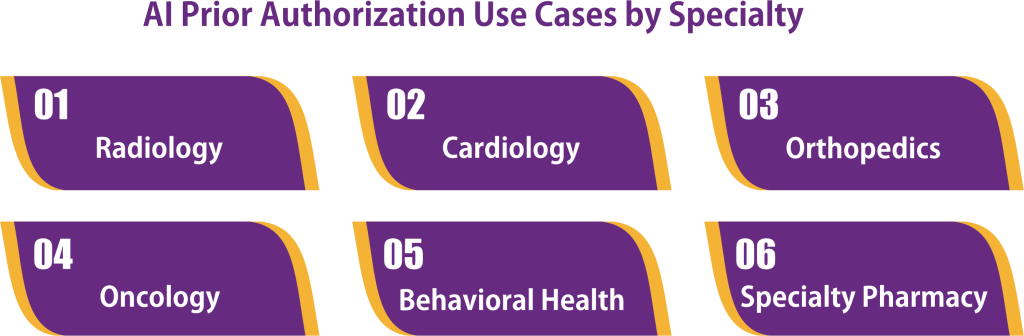
AI Prior Authorization Use Cases by Specialty
Prior authorization challenges vary significantly across medical specialties. Some specialties face extremely high authorization volumes, complex clinical documentation requirements, and frequent payer scrutiny. AI helps streamline these specialty-specific workflows by automating repetitive administrative tasks while improving approval accuracy.
1. Radiology
Radiology departments frequently deal with prior authorizations for:
- MRIs
- CT scans
- PET scans
- Advanced imaging procedures
These requests often require detailed clinical justification and payer-specific criteria checks.
AI helps radiology providers by:
- Automatically extracting imaging indications from physician notes
- Matching requests against payer imaging guidelines
- Identifying missing documentation before submission
- Accelerating approval turnaround times
This reduces scheduling delays and helps patients receive diagnostic imaging faster.
2. Cardiology
Cardiology prior authorizations can be highly complex due to expensive procedures, advanced diagnostics, and long-term treatment plans.
AI supports cardiology workflows by automating:
- Procedure authorization reviews
- Medical necessity validation
- Eligibility verification
- Documentation extraction from EHRs
For high-cost cardiac procedures, predictive AI can also flag high-risk denials before submission.
3. Orthopedics
Orthopedic practices often require authorizations for surgeries, injections, rehabilitation services, and durable medical equipment.
Manual workflows create significant scheduling disruptions when approvals are delayed.
AI improves orthopedic authorization management by:
- Tracking authorization timelines
- Monitoring expiration dates
- Preventing documentation gaps
- Automating payer follow-ups
This allows orthopedic providers to reduce surgery delays and improve patient coordination.
4. Oncology
Oncology prior authorization is especially time-sensitive because treatment delays can directly affect patient outcomes.
AI helps oncology providers:
- Accelerate chemotherapy approvals
- Verify specialty drug coverage
- Streamline treatment authorization workflows
- Reduce delays for urgent care plans
By automating repetitive administrative processes, oncology teams can focus more on patient care coordination and treatment planning.
5. Behavioral Health
Behavioral health providers frequently face authorization complexities related to:
- Therapy visit limitations
- Inpatient treatment approvals
- Substance abuse programs
- Ongoing care extensions
AI can continuously monitor authorization status, treatment eligibility, and payer limitations to reduce care interruptions and administrative burden.
6. Specialty Pharmacy
Specialty medications often require extensive documentation, clinical reviews, and payer communication.
AI-powered automation helps specialty pharmacies:
- Verify medication coverage
- Submit supporting clinical evidence
- Automate refill authorization workflows
- Monitor payer responses in real time
This speeds medication access for patients while reducing operational overhead for pharmacy teams.
Integration With EHRs and RCM Systems
For AI prior authorization to deliver real value, it must integrate seamlessly with existing healthcare systems. Modern AI platforms connect directly with Electronic Health Records (EHRs), Practice Management Systems (PMS), and Revenue Cycle Management (RCM) software to automate workflows without disrupting operations.
AI integrations help providers:
- Pull patient data automatically
- Extract clinical documentation in real time
- Verify eligibility instantly
- Submit authorizations electronically
- Sync approval statuses across systems
Most advanced solutions support:
- FHIR APIs
- HL7 integrations
- Electronic Prior Authorization (ePA) standards
- Real-time payer connectivity
AI platforms can also integrate with major healthcare systems like Epic, Cerner, Athenahealth, and eClinicalWorks, allowing providers to automate workflows directly inside their existing infrastructure.
The result is a unified ecosystem where prior authorization no longer operates as a disconnected administrative task.
Compliance, Security & AI Governance in Healthcare
As AI adoption grows in healthcare, compliance and security remain critical concerns. Prior authorization workflows involve sensitive patient information, making data protection and regulatory compliance essential.
Healthcare AI systems must comply with:
- HIPAA regulations
- Data encryption standards
- Access control requirements
- Audit trail documentation
- Healthcare interoperability guidelines
Leading AI solutions also use human-in-the-loop models, where staff can review high-risk or exception-based cases before final submission.
Beyond security, healthcare organizations must also address:
- AI transparency
- Bias prevention
- Ethical decision-making
- Regulatory accountability
The goal of AI is not to replace clinical judgment but to support healthcare teams with faster, more accurate administrative decision-making.
Organizations that prioritize responsible AI governance will be better positioned to scale automation safely and compliantly.
Challenges of AI in Prior Authorization
Although AI offers major advantages, implementation is not without challenges. Healthcare organizations must prepare for both technical and operational hurdles during adoption.
Legacy System Integration: Older healthcare systems may lack interoperability, making AI integration more complex and time-consuming.
Poor Data Quality: AI relies heavily on accurate patient and clinical data. Incomplete or inconsistent records can reduce automation accuracy.
Payer Variability: Insurance companies frequently update authorization requirements, creating ongoing workflow complexity that AI systems must continuously adapt to.
Staff Training and Adoption: Employees may initially resist workflow changes or fear automation replacing their roles. Proper training and change management are essential for successful adoption.
Over-Reliance on Automation: AI should enhance human decision-making, not replace it entirely. Human oversight remains critical for complex cases, appeals, and exception handling.
Despite these challenges, most healthcare organizations find that the long-term efficiency gains far outweigh the implementation obstacles.
The Future of Prior Authorization With AI
The future of prior authorization is moving toward fully digital, intelligent automation. As AI technology evolves, healthcare organizations will increasingly shift from reactive administrative workflows to predictive, real-time authorization ecosystems.
Emerging trends include:
- Autonomous revenue cycle operations
- Real-time approvals
- Predictive denial prevention
- AI-powered appeals generation
- Voice AI payer negotiations
- End-to-end workflow automation
Electronic Prior Authorization (ePA) adoption and FHIR-based interoperability standards will also continue accelerating industry-wide transformation.
In the coming years, AI will likely reduce manual prior authorization work to a minimal exception-based process where human staff focus only on complex cases requiring strategic oversight.
Healthcare organizations that adopt AI early will gain a significant advantage through:
- Faster reimbursements
- Lower operational costs
- Improved patient satisfaction
- Greater scalability
- Stronger financial performance
The era of manually chasing prior authorizations is rapidly coming to an end.
How to Choose the Right AI Prior Authorization Solution?
Not all AI prior authorization platforms offer the same capabilities. Choosing the right solution requires evaluating both operational needs and long-term scalability.
Look for End-to-End Automation
The best platforms automate the complete authorization workflow, including:
- Eligibility verification
- Documentation extraction
- Form submission
- Status tracking
- Denial prevention
- Follow-up automation
Avoid solutions that only handle one part of the process.
Prioritize EHR and RCM Integration
Choose a platform that integrates seamlessly with your:
- EHR system
- Practice management software
- Billing platform
- Clearinghouse workflows
Strong integration reduces manual work and improves data accuracy.
Evaluate AI Accuracy and Rule Management
AI should continuously adapt to changing payer requirements and maintain high submission accuracy.
Ask vendors:
- How often are payer rules updated
- How denial prediction works
- Whether human review options exist
- How exception cases are managed
Assess Scalability
Your authorization volume will grow over time. Select a solution that can scale across:
- Multiple specialties
- Multiple locations
- Growing patient volumes
- Expanding payer networks
Scalable AI reduces the need for constant staffing increases.
Review Security and Compliance Standards
Because prior authorization involves protected health information, security is non-negotiable.
Verify that the platform supports:
- HIPAA compliance
- Data encryption
- Audit trails
- Access controls
- Secure API integrations
Measure ROI Potential
A strong AI solution should deliver measurable improvements such as:
- Faster approvals
- Lower denial rates
- Reduced labor costs
- Improved reimbursement speed
- Higher staff productivity
The right platform should generate both operational and financial returns.
Final Thoughts
Manual prior authorization has become one of the biggest administrative burdens in healthcare. Endless follow-up calls, repetitive documentation tasks, approval delays, and preventable denials are slowing patient care while increasing operational costs across the revenue cycle.
AI is changing that reality.
By automating eligibility checks, extracting clinical documentation, validating payer requirements, tracking authorization statuses, and reducing denial risks, AI-powered prior authorization solutions are helping healthcare organizations operate faster, smarter, and more efficiently.
The biggest impact is not just automation, it’s transformation. Healthcare teams no longer need to spend valuable hours chasing approvals manually. Instead, they can focus on improving patient outcomes, managing complex cases, and strengthening financial performance.