
Healthcare organizations lose billions every year to denied claims, delayed reimbursements, and preventable billing errors. Traditional claim scrubbing methods often catch issues too late, after submission, rejection, and costly rework have already happened. As payer rules become more complex and administrative workloads continue to rise, manual processes simply can’t keep up.
That’s where real-time AI claim scrubbing is changing the game.
By using artificial intelligence, machine learning, and predictive analytics, healthcare providers can now identify coding mistakes, eligibility issues, missing modifiers, and compliance risks instantly, before a claim is submitted. Instead of reacting to denials, organizations can proactively prevent them, improve clean claim rates, accelerate cash flow, and reduce the burden on billing teams.
What Is Real-Time Claim Scrubbing?
Real-time claim scrubbing is an AI-powered process that automatically reviews medical claims for errors, inconsistencies, and compliance issues before they are submitted to payers. Its primary goal is to ensure claims are “clean” the first time, reducing rejections, denials, and reimbursement delays.
Traditional claim scrubbing systems typically work in batches and rely on static rule sets. In contrast, real-time AI claim scrubbing continuously analyzes claims as they are created, using machine learning and predictive analytics to identify issues instantly.
This proactive approach helps healthcare organizations improve billing accuracy, streamline revenue cycle management, and reduce administrative costs.
What Makes It “Real-Time”?
The “real-time” aspect means claims are validated immediately during coding, documentation, or claim generation, not hours or days later.
AI systems can instantly:
- Verify patient eligibility
- Detect coding inconsistencies
- Check payer-specific requirements
- Identify missing modifiers
- Flag authorization issues
- Predict denial risks before submission
This allows billing teams to correct problems instantly instead of reworking denied claims later.
Traditional vs AI-Powered Claim Scrubbing
| Traditional Claim Scrubbing | Real-Time AI Claim Scrubbing |
| Manual and rule-based | AI-driven and automated |
| Batch processing | Instant validation |
| Reactive denial management | Predictive denial prevention |
| Static payer rules | Continuously learning algorithms |
| Higher rework rates | Higher clean claim rates |
| Labor-intensive workflows | Scalable automation |
By moving from reactive correction to proactive prevention, AI-powered claim scrubbing transforms medical billing into a faster, more intelligent revenue protection system.
Why Claim Denials Happen in Healthcare Billing?
Claim denials remain one of the biggest financial challenges in healthcare revenue cycle management. Even small billing mistakes can delay reimbursements, increase administrative workload, and create significant revenue leakage.
Most denied claims are preventable, yet many organizations still rely on outdated manual review processes that fail to catch errors early enough.
Common Causes of Claim Denials
Several issues commonly trigger claim rejections and denials, including:
- Incorrect ICD-10 or CPT codes
- Missing or invalid patient information
- Eligibility verification failures
- Modifier errors
- Duplicate claim submissions
- Missing prior authorizations
- Incomplete clinical documentation
- Payer-specific formatting violations
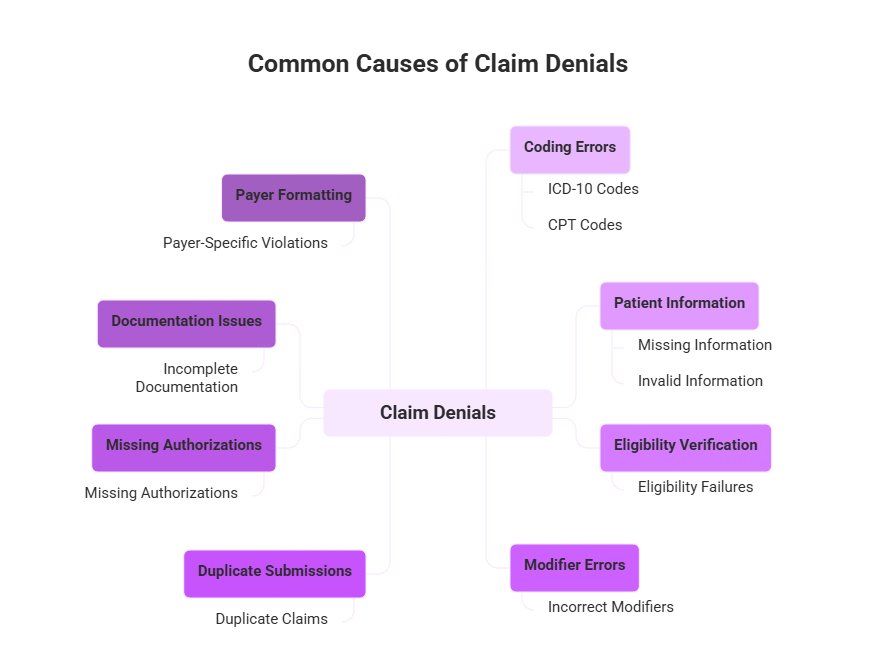
Because payer rules frequently change, even experienced billing teams struggle to maintain accuracy manually.
The Financial Impact of Denials
Denied claims do far more than delay payments. They create a ripple effect across the entire revenue cycle.
Healthcare organizations often face:
- Increased rework costs
- Slower cash flow
- Higher accounts receivable days
- Administrative burnout
- Lost revenue opportunities
- Reduced operational efficiency
In many cases, denied claims are never successfully resubmitted, leading to permanent revenue loss.
This is why healthcare providers are increasingly adopting AI-powered denial prevention tools that identify risks before claims ever reach the payer.
How AI-Powered Claim Scrubbing Works?
AI-powered claim scrubbing combines machine learning, automation, and predictive analytics to identify billing issues in real time before claims are submitted.
Unlike traditional systems that rely solely on fixed rule sets, AI continuously learns from historical claims data, payer responses, and denial patterns to improve accuracy over time.
Machine Learning for Error Detection
Machine learning algorithms analyze massive amounts of historical billing and denial data to identify patterns linked to rejected claims.
The system can detect:
- Coding inconsistencies
- High-risk claim combinations
- Frequently denied procedures
- Payer-specific rejection trends
- Unusual billing behavior
As the AI processes more claims, it becomes more accurate at predicting denial risks and recommending corrections.
Natural Language Processing (NLP)
Natural Language Processing helps AI interpret physician notes and clinical documentation.
This enables the system to:
- Match documentation with billing codes
- Identify missing clinical details
- Reduce coding discrepancies
- Improve documentation accuracy
- Support automated coding workflows
NLP significantly reduces the gap between clinical documentation and billing compliance.
Real-Time Rules Engine
AI claim scrubbing platforms use dynamic rules engines that continuously update based on payer requirements and regulatory changes.
These systems can instantly validate:
- Insurance eligibility
- Medical necessity
- Modifier usage
- Authorization requirements
- Coding compliance
- Claim formatting standards
This ensures claims meet payer-specific requirements before submission.
Predictive Denial Prevention
One of the most powerful capabilities of AI claim scrubbing is predictive analytics.
Instead of simply finding current errors, AI predicts which claims are most likely to be denied based on historical trends and payer behavior.
The system can then:
- Assign risk scores to claims
- Recommend corrective actions
- Prioritize high-risk claims for review
- Prevent avoidable denials proactively
This shifts healthcare billing from reactive problem-solving to proactive revenue optimization.
Step-by-Step Workflow of AI Claim Scrubbing
Understanding how AI claim scrubbing works in practice helps healthcare organizations see where automation delivers the greatest impact.
Here’s a simplified breakdown of the real-time AI claim scrubbing workflow:
Step 1: Data Extraction from EHR Systems
The AI platform extracts patient demographics, insurance details, clinical documentation, and procedure data directly from electronic health records (EHRs).
This eliminates manual data entry and reduces transcription errors.
Step 2: Automated Coding Validation
AI reviews ICD-10, CPT, and HCPCS codes for:
- Accuracy
- Completeness
- Modifier compatibility
- Medical necessity alignment
The system instantly flags incorrect or missing codes.
Step 3: Eligibility and Authorization Verification
The platform verifies:
- Insurance coverage
- Policy status
- Prior authorization requirements
- Referral validations
Real-time verification prevents avoidable eligibility denials.
Step 4: Real-Time Error Detection
AI scans claims against payer-specific rules and historical denial patterns to identify:
- Missing fields
- Duplicate claims
- Formatting issues
- Compliance risks
- High-risk claim combinations
Errors are flagged immediately for correction.
Step 5: AI Risk Scoring
Each claim receives a predictive denial risk score based on historical payer outcomes and claim complexity.
Billing teams can prioritize high-risk claims before submission.
Step 6: Automated Correction Recommendations
AI suggests corrective actions such as:
- Updating modifiers
- Fixing coding mismatches
- Adding missing documentation
- Resolving eligibility conflicts
This reduces manual review time significantly.
Step 7: Clean Claim Submission
Once validated, the claim is submitted with a significantly higher probability of first-pass acceptance.
The result is:
- Faster reimbursements
- Fewer denials
- Improved clean claim rates
- Lower administrative overhead

This real-time workflow enables healthcare organizations to turn claim scrubbing from a reactive billing task into a proactive revenue protection strategy.
Key Benefits of Real-Time AI Claim Scrubbing
Healthcare organizations are under constant pressure to reduce denials, improve operational efficiency, and accelerate reimbursements. Real-time AI claim scrubbing addresses all three by transforming how claims are validated before submission.
Instead of relying on manual reviews and reactive corrections, providers can proactively prevent billing errors and protect revenue at scale.
- Reduced Claim Denials
- Faster Reimbursements
- Higher Clean Claim Rates
- Improved Staff Productivity
- Lower Administrative Costs
- Better Compliance and Accuracy
- Scalable Revenue Cycle Operations
AI Claim Scrubbing vs Traditional Medical Billing Audits
Traditional billing audits have long been used to identify errors in healthcare claims. However, these methods are often slow, labor-intensive, and reactive.
AI-powered claim scrubbing introduces a faster and more intelligent approach by identifying risks before claims are submitted.
Traditional Medical Billing Audits
Traditional audits usually involve:
- Manual claim reviews
- Static rule-based software
- Periodic quality checks
- Post-submission denial analysis
While these methods can identify certain issues, they often fail to detect errors early enough to prevent denials entirely.
Billing teams frequently spend valuable time correcting claims after rejection rather than preventing errors up front.
How AI Claim Scrubbing Is Different?
AI-driven systems continuously analyze claims in real time using:
- Machine learning
- Predictive analytics
- Historical denial patterns
- Dynamic payer rules
- Natural language processing
This enables healthcare organizations to shift from reactive denial management to proactive revenue protection.
AI vs Traditional Audits Comparison
| Feature | Traditional Audits | AI Claim Scrubbing |
| Review Speed | Slow | Real-time |
| Error Detection | Limited | Predictive |
| Learning Capability | Static | Continuously improving |
| Labor Dependency | High | Low |
| Scalability | Limited | Highly scalable |
| Denial Prevention | Reactive | Proactive |
| Payer Rule Adaptation | Manual updates | Automated updates |
| Operational Efficiency | Moderate | High |
Why Healthcare Providers Are Transitioning to AI
Modern healthcare billing environments are too complex for manual processes alone.
Providers are adopting AI claim scrubbing because it offers:
- Faster claims processing
- Reduced denial rates
- Improved clean claim performance
- Lower administrative burden
- Better financial predictability
As payer requirements continue evolving, AI is becoming essential for maintaining revenue cycle efficiency and competitiveness.
Use Cases of AI Claim Scrubbing
AI-powered claim scrubbing is no longer a future concept; it is already being used across the healthcare industry to improve billing accuracy, reduce denials, and optimize revenue cycle performance.
Different healthcare organizations use AI in unique ways depending on their billing complexity and operational scale.
1. Hospitals and Health Systems
Large hospitals process thousands of claims daily, making manual review nearly impossible at scale.
AI helps hospitals:
- Detect high-risk claims instantly
- Reduce coding errors
- Improve inpatient billing accuracy
- Automate payer-specific validation
- Minimize reimbursement delays
This improves both operational efficiency and financial performance.
2. Specialty Clinics
Specialty practices often face highly specific coding and authorization requirements.
AI claim scrubbing helps specialty clinics:
- Validate complex procedure codes
- Reduce modifier-related denials
- Improve documentation accuracy
- Streamline specialty payer compliance
This is especially valuable in cardiology, oncology, orthopedics, and radiology billing.
3. Telehealth Providers
Telehealth billing includes evolving payer regulations and virtual care coding requirements.
AI systems help telehealth organizations:
- Verify virtual visit eligibility
- Validate telehealth modifiers
- Monitor payer policy changes
- Reduce remote care billing errors
As virtual healthcare expands, automated claim validation becomes increasingly important.
4. Revenue Cycle Management (RCM) Companies
Third-party billing and RCM providers use AI to manage large claim volumes efficiently.
AI enables them to:
- Automate repetitive workflows
- Improve client clean claim rates
- Reduce denial management workload
- Deliver faster reimbursement performance
This creates a competitive advantage in the healthcare outsourcing market.
5. Insurance Payers
Some insurance companies also use AI internally to detect:
- Fraud risks
- Duplicate claims
- Coding anomalies
- Documentation inconsistencies
This increases pressure on providers to submit highly accurate claims from the start.
Example of AI Claim Scrubbing Impact
A healthcare organization struggling with high denial rates implemented a real-time AI claim scrubbing platform.
Before AI Implementation
- Denial rate: 18%
- Slow reimbursement cycles
- High administrative rework
- Frequent coding inconsistencies
After AI Implementation
- Denial rate reduced to 6%
- Faster claim approvals
- Improved clean claim rate
- Lower operational costs
This demonstrates how predictive claim validation can directly improve healthcare revenue performance.
Compliance, HIPAA, and Security Concerns
While AI claims scrubbing offers major operational benefits, healthcare organizations must also address compliance, privacy, and data security concerns.
Because medical billing involves sensitive patient information, AI systems must align with strict healthcare regulations and cybersecurity standards.
HIPAA Compliance: Any AI-powered billing platform handling protected health information (PHI) must comply with HIPAA requirements.
Healthcare providers should verify that AI vendors maintain strong compliance frameworks before implementation.
Data Encryption and Security: AI claim scrubbing systems process large volumes of financial and clinical data, making cybersecurity essential.
Audit Trails and Transparency: Healthcare organizations must maintain clear audit trails for billing and compliance purposes.
AI systems should provide:
- Claim validation history
- Error tracking logs
- Correction records
- User activity reports
- Decision transparency
This improves accountability and simplifies compliance reporting.
AI Accuracy and Bias Risks: Although AI improves billing efficiency, it is not perfect.
Poor-quality data or biased training models can lead to:
- Incorrect recommendations
- Coding inaccuracies
- Inconsistent denial predictions
Healthcare organizations should combine AI automation with human oversight to ensure billing accuracy and compliance integrity.
Choosing a Secure AI Vendor: Before adopting an AI claim scrubbing solution, providers should evaluate:
- HIPAA compliance certifications
- Security infrastructure
- Data governance policies
- System transparency
- Integration security standards
A secure and compliant AI platform protects both patient data and organizational revenue.
Challenges of Implementing AI Claim Scrubbing
Although AI-powered claim scrubbing delivers significant operational and financial benefits, implementation is not always simple. Healthcare organizations must overcome technical, operational, and organizational challenges to maximize ROI.
Understanding these barriers early helps providers create a smoother AI adoption strategy.
Integration with Legacy Systems
Many healthcare organizations still rely on outdated billing platforms and legacy EHR systems that were not designed for AI integration.
Common challenges include:
- Limited interoperability
- Data silos
- Inconsistent formatting
- Slow system performance
- Complex migration requirements
Successful implementation often requires strong API integration and vendor collaboration to ensure seamless data exchange.
Data Quality Issues
AI systems are only as effective as the data they analyze.
Incomplete or inaccurate clinical and billing data can reduce:
- Prediction accuracy
- Coding validation quality
- Denial prevention performance
Organizations must improve data standardization and documentation quality before fully scaling AI claim scrubbing solutions.
Staff Resistance and Training
Some billing teams may view AI as disruptive or fear that automation could replace manual roles.
Without proper onboarding, organizations may face:
- Low adoption rates
- Workflow confusion
- Reduced productivity during transition
- Resistance to new processes
Training staff on how AI supports, rather than replaces, billing operations is critical for long-term success.
Upfront Investment Costs
Implementing AI claim scrubbing software may require:
- Platform licensing
- System integration
- Staff training
- Infrastructure upgrades
- Workflow redesign
While long-term ROI is often substantial, smaller healthcare organizations may initially struggle with implementation costs.
Constantly Changing Payer Rules
Insurance payer requirements frequently change, creating ongoing billing complexity.
AI systems must continuously adapt to:
- New coding standards
- Policy updates
- Authorization requirements
- Reimbursement rule changes
Organizations should choose vendors that provide real-time payer rule updates and continuous machine learning optimization.
Balancing Automation with Human Oversight
AI can automate many billing tasks, but human expertise remains essential for:
- Complex claim reviews
- Appeals management
- Exception handling
- Compliance monitoring
The most effective strategy combines AI automation with experienced revenue cycle professionals.
How to Choose the Right AI Claim Scrubbing Software
Not all AI claim scrubbing platforms offer the same capabilities. Choosing the right solution can significantly impact denial reduction, reimbursement speed, and operational efficiency.
Healthcare organizations should evaluate software based on scalability, automation quality, compliance, and integration capabilities.
Look for Real-Time Validation Capabilities
Many vendors advertise AI features, but some systems still operate using delayed or batch-based workflows.
A strong AI claim scrubbing platform should provide:
- Instant claim validation
- Real-time payer rule checks
- Immediate error detection
- Live eligibility verification
- Predictive denial alerts
Real-time processing helps organizations correct issues before submission instead of after rejection.
Evaluate AI and Predictive Analytics Features
Advanced AI systems should do more than detect simple coding mistakes.
Look for features such as:
- Predictive denial scoring
- Machine learning optimization
- Historical claim analysis
- Automated correction suggestions
- Intelligent workflow prioritization
These capabilities improve clean claim rates and reduce administrative rework.
Ensure EHR and Billing System Integration
Seamless integration is essential for operational efficiency.
The software should integrate with:
- EHR platforms
- Practice management systems
- Clearinghouses
- Revenue cycle management tools
- Insurance verification systems
Strong interoperability reduces manual work and improves workflow automation.
Prioritize Compliance and Security
Because healthcare billing involves sensitive patient information, compliance and cybersecurity should be non-negotiable.
The platform should support:
- HIPAA compliance
- End-to-end encryption
- Audit trails
- Access controls
- Secure cloud infrastructure
Organizations should also verify vendor certifications and security protocols before implementation.
Analyze Reporting and Analytics Dashboards
Comprehensive reporting tools help billing teams track performance and identify improvement opportunities.
Useful analytics features include:
- Denial trend analysis
- Clean claim rate monitoring
- Revenue impact tracking
- Payer-specific insights
- Productivity metrics
Data visibility is essential for long-term revenue cycle optimization.
Questions to Ask AI Claim Scrubbing Vendors
Before selecting a platform, healthcare organizations should ask vendors:
- Does the platform support real-time payer rule updates?
- How accurate is the denial prediction model?
- Can the software integrate with Epic, Cerner, or existing systems?
- What measurable denial reduction results do clients typically achieve?
- How does the platform handle compliance and security?
- What implementation support and training are provided?
The right vendor should function as a long-term revenue cycle partner, not just a software provider.
Summary
Healthcare billing is becoming more complex, and traditional claim scrubbing methods are no longer enough to prevent costly denials and revenue delays. Real-time AI claim scrubbing gives healthcare organizations a smarter and more proactive way to protect revenue before claims are ever submitted.
By combining machine learning, predictive analytics, and real-time validation, AI helps providers reduce denials, improve clean claim rates, accelerate reimbursements, and lower administrative costs. Instead of reacting to rejected claims, organizations can now prevent many billing issues before they happen.
As payer requirements continue evolving, AI-powered revenue cycle management will become increasingly essential for healthcare organizations seeking operational efficiency, financial stability, and scalable growth.