Healthcare organizations today face increasing pressure to improve operational efficiency, reduce administrative burdens, and accelerate reimbursement cycles. Yet despite advancements in healthcare technology, claim errors continue to be one of the most significant challenges affecting revenue cycle performance. From incomplete documentation and coding inaccuracies to eligibility verification issues and missing prior authorizations, even minor mistakes can lead to claim denials, delayed payments, and lost revenue.
As healthcare providers generate growing volumes of patient data through Electronic Health Records (EHRs) and Electronic Medical Records (EMRs), manually managing and validating this information has become increasingly difficult. Traditional workflows often rely on human review processes that are time-consuming, error-prone, and unable to keep pace with modern healthcare demands.
This is where AI-powered EHR/EMR integration is transforming healthcare revenue cycle management.
By combining Artificial Intelligence (AI), Natural Language Processing (NLP), Machine Learning (ML), and Predictive Analytics, healthcare organizations can automatically convert clinical documentation into structured billing data, identify potential claim errors before submission, and reduce denial rates through proactive intervention.
Rather than functioning solely as digital repositories for patient information, modern EHR and EMR systems are evolving into intelligent platforms capable of supporting medical coding, claims management, denial prevention, and revenue cycle optimization.
In this article, we explore how AI-powered EHR/EMR integration uses NLP and predictive intelligence to reduce claim errors, improve clean claim rates, and help healthcare organizations achieve stronger financial outcomes.
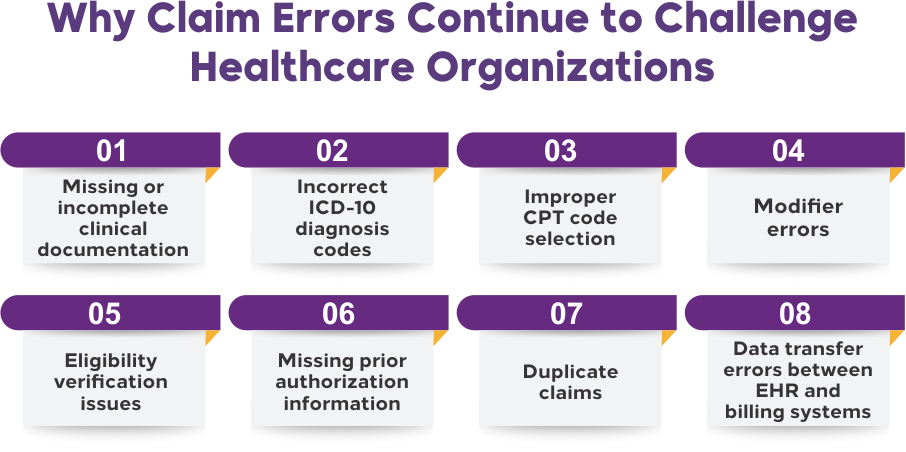
Why Claim Errors Continue to Challenge Healthcare Organizations
Claim errors remain one of the leading causes of revenue leakage across healthcare organizations. Even practices with experienced billing teams frequently struggle with denials resulting from inaccurate coding, incomplete documentation, eligibility issues, and data mismatches between clinical and billing systems.
Some of the most common claim errors include:
- Missing or incomplete clinical documentation
- Incorrect ICD-10 diagnosis codes
- Improper CPT code selection
- Modifier errors
- Eligibility verification issues
- Missing prior authorization information
- Duplicate claims
- Data transfer errors between EHR and billing systems
- Medical necessity documentation deficiencies
The challenge is compounded by the sheer volume of healthcare data generated daily. Physicians create extensive clinical notes, discharge summaries, imaging reports, and treatment documentation that must be accurately translated into billable information.
When healthcare organizations rely primarily on manual processes, even highly trained staff can overlook critical details that result in claim denials.
The consequences can be substantial:
- Increased denial rates
- Higher administrative costs
- Delayed reimbursements
- Increased days in accounts receivable (A/R)
- Revenue leakage
- Staff burnout
- Reduced patient satisfaction
To address these challenges, healthcare organizations are increasingly adopting AI-driven medical billing solutions that integrate directly with EHR and EMR platforms.
Understanding AI-Powered EHR/EMR Integration
AI-powered EHR/EMR integration refers to the use of artificial intelligence technologies within electronic health record systems to improve the accuracy, efficiency, and intelligence of clinical and administrative workflows.
Unlike traditional EHR integration, which focuses primarily on data exchange and interoperability, AI-enhanced systems actively analyze information, identify patterns, and generate actionable insights.
These intelligent systems leverage:
Artificial Intelligence (AI)
AI enables systems to analyze large volumes of healthcare data, recognize patterns, and automate repetitive tasks that traditionally required manual intervention.
Machine Learning (ML)
Machine learning algorithms continuously learn from historical healthcare data, improving their ability to identify coding issues, predict claim denials, and optimize billing workflows.
Natural Language Processing (NLP)
NLP allows systems to interpret unstructured clinical documentation such as physician notes, discharge summaries, operative reports, and patient narratives.
Predictive Analytics
Predictive intelligence uses historical claims, payer behavior, and denial patterns to forecast potential issues before claims are submitted.
Together, these technologies transform EHR integration for medical billing from a passive data exchange process into an intelligent revenue cycle management tool.
How NLP Converts Clinical Documentation into Accurate Billing Data
One of the most powerful applications of AI in medical billing is Natural Language Processing (NLP).
Healthcare providers generate significant amounts of unstructured data during patient encounters. Clinical notes, operative reports, discharge summaries, and physician narratives contain valuable information necessary for coding and billing, but extracting relevant details manually can be time-consuming and prone to error.
NLP in healthcare solves this challenge by enabling computers to understand, interpret, and analyze human language.
From Unstructured Notes to Structured Billing Data
Consider a physician documenting a patient encounter involving diabetes, hypertension, and chronic kidney disease.
Rather than requiring coders to manually review lengthy documentation, NLP systems can automatically:
- Identify diagnoses
- Extract treatment information
- Recognize clinical terminology
- Map findings to ICD-10 codes
- Support CPT code selection
- Detect missing documentation
This process significantly improves coding accuracy while reducing administrative burden.
Improving ICD-10 and CPT Coding Accuracy
Accurate medical coding is essential for clean claim submission.
AI-driven medical coding solutions can analyze physician documentation and identify the most appropriate ICD-10 and CPT codes based on clinical evidence. By validating coding decisions against documentation, NLP helps reduce:
- Under-coding
- Over-coding
- Missing diagnosis specificity
- Inconsistent coding practices
As a result, healthcare organizations experience fewer coding-related denials and stronger reimbursement performance.
Identifying Documentation Gaps Before Claims Are Submitted
One of the primary causes of claim denials is insufficient documentation.
NLP-powered systems can proactively identify:
- Missing diagnosis details
- Incomplete treatment documentation
- Unsupported procedure codes
- Missing medical necessity information
- Incomplete patient encounter records
By alerting providers before claim submission, healthcare organizations can resolve deficiencies early and prevent costly denials.
The Role of Predictive Intelligence in Preventing Claim Errors
While NLP focuses on understanding clinical documentation, predictive intelligence focuses on anticipating future claim outcomes.
Traditional denial management strategies are reactive. Claims are submitted, denied, reviewed, corrected, and resubmitted.
This process is costly, inefficient, and resource-intensive.
Predictive analytics for healthcare claims changes this approach by identifying denial risks before claims ever leave the organization.
What Is Predictive Intelligence?
Predictive intelligence uses machine learning algorithms to analyze:
- Historical claims data
- Payer behavior
- Denial trends
- Coding patterns
- Documentation quality
- Eligibility verification data

By recognizing recurring patterns, AI systems can estimate the likelihood that a claim will be denied.
Predictive Denial Prevention
Instead of waiting for denials to occur, predictive claim scrubbing systems can flag claims with elevated risk factors.
Examples include:
- Missing supporting documentation
- High-risk payer combinations
- Coding inconsistencies
- Eligibility concerns
- Authorization issues
- Medical necessity risks
Billing teams can address these issues proactively, improving first-pass acceptance rates and reducing rework.
Intelligent Claims Processing
Modern AI-powered claims management platforms continuously learn from payer responses and denial outcomes.
This enables organizations to:
- Improve clean claim rates
- Reduce denial frequency
- Accelerate reimbursement cycles
- Lower administrative costs
- Optimize revenue cycle performance
As healthcare reimbursement grows increasingly complex, predictive intelligence is becoming an essential component of denial prevention technology and intelligent claims processing.
Final Thoughts
AI-powered EHR/EMR integration is transforming healthcare revenue cycle management by combining NLP, machine learning, and predictive intelligence to improve coding accuracy, prevent claim denials, and reduce administrative inefficiencies. By identifying potential errors before submission, healthcare organizations can achieve higher clean claim rates and faster reimbursements.
As reimbursement requirements become increasingly complex, proactive claims management is no longer optional. Healthcare providers that leverage intelligent automation and predictive analytics will be better positioned to optimize financial performance, streamline workflows, and strengthen long-term revenue cycle outcomes while maintaining a focus on quality patient care.