Medical billing errors are one of the biggest hidden causes of revenue leakage in healthcare practices. From coding inaccuracies and claim denials to missing documentation and payer-rule violations, even small billing mistakes can delay reimbursements and disrupt cash flow.
As healthcare billing becomes more complex, many providers are asking an important question:
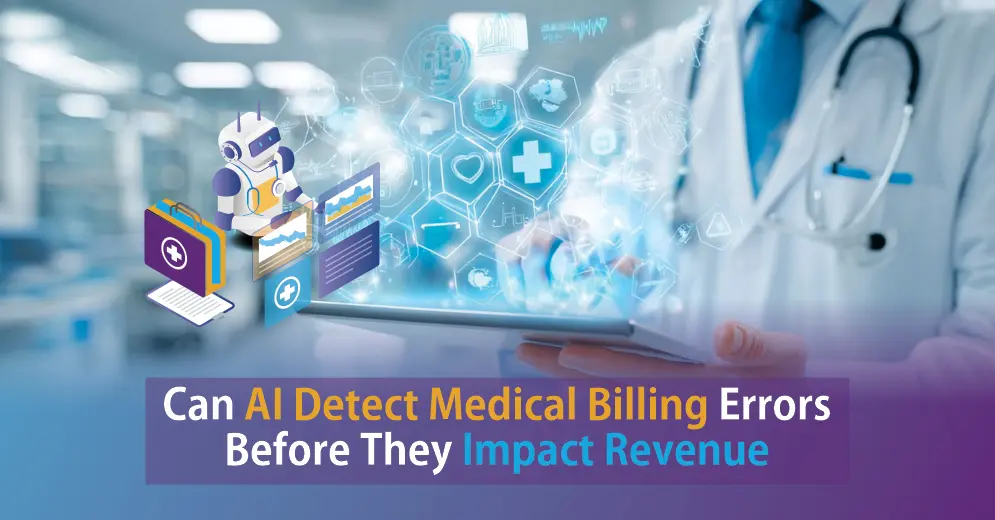
Can AI detect medical billing errors before they impact revenue?
The short answer is yes — but not in the way many people think.
Artificial intelligence is not replacing medical billing teams entirely. Instead, AI-powered revenue cycle management systems are helping practices identify high-risk claims, reduce preventable denials, and improve clean claim rates before claims are submitted to insurance payers.
For modern healthcare organizations, AI medical billing is becoming less of a luxury and more of a financial necessity.
Why Medical Billing Errors Cost Practices So Much Money
Most healthcare providers underestimate how expensive billing mistakes really are.
A single denied claim does not just delay reimbursement. It creates an entire chain of administrative work:
- Reviewing the denial
- Identifying the error
- Correcting documentation
- Resubmitting the claim
- Following up with insurance companies
- Tracking payment status
That process consumes valuable time and increases operational costs.
Now multiply that by dozens — or even hundreds — of denied claims every month.
The financial impact becomes significant very quickly.
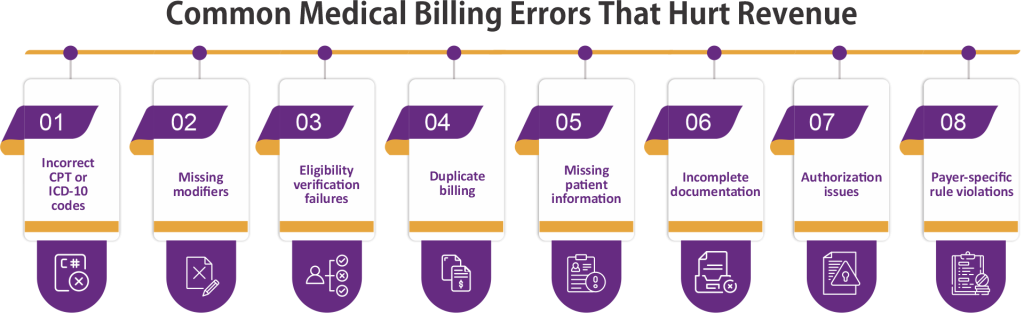
Common Medical Billing Errors That Hurt Revenue
AI-powered medical billing systems are designed to identify issues like:
- Incorrect CPT or ICD-10 codes
- Missing modifiers
- Eligibility verification failures
- Duplicate billing
- Missing patient information
- Incomplete documentation
- Authorization issues
- Payer-specific rule violations
- Incorrect insurance details
- Coding inconsistencies
Many of these errors are preventable, yet they remain common in manual medical billing workflows.
The Real Problem Isn’t the Error — It’s the Revenue Delay
Most competitor blogs focus only on automation benefits.
What they fail to explain is how billing errors directly affect healthcare cash flow.
Every delayed or rejected claim slows down revenue cycle management.
For example:
- Claims stuck in review increase accounts receivable (A/R)
- Delayed reimbursements hurt operational stability
- Staff spend hours reworking denied claims
- Physicians wait longer to collect earned revenue
- Administrative overhead continues growing
Over time, these small inefficiencies create serious financial pressure on healthcare practices.
AI medical billing systems help reduce this risk by detecting errors before claims are submitted.
That distinction matters.
Instead of reacting to denials after revenue is delayed, AI helps practices prevent avoidable revenue disruption in the first place.
How AI Detects Medical Billing Errors Before Submission
Modern AI-powered revenue cycle management platforms use machine learning, predictive analytics, and automated claim scrubbing to analyze claims before they reach payers.
Unlike manual review processes, AI can scan large volumes of billing data in seconds.
Here’s how AI-driven billing error detection works:
1. Automated Claim Scrubbing
AI reviews claims for:
- Coding mismatches
- Missing fields
- Invalid modifiers
- Documentation inconsistencies
- Payer-specific formatting requirements
This improves the clean claim rate and reduces preventable rejections.
2. Predictive Denial Analysis
AI systems analyze historical denial patterns to identify claims with a high likelihood of rejection.
For example, the system may flag:
- Frequently denied procedures
- High-risk payer combinations
- Missing authorization patterns
- Common coding inconsistencies
This allows billing teams to fix issues before claims are submitted.
3. Real-Time Eligibility Verification
One of the most common causes of claim denials is incorrect insurance eligibility information.
AI-powered systems can automatically:
- Verify coverage
- Detect expired policies
- Confirm payer details
- Identify authorization requirements
This reduces delays caused by eligibility-related denials.
4. Coding Accuracy Support
AI medical billing software can assist coders by identifying:
- Missing CPT modifiers
- ICD-10 mismatches
- Documentation gaps
- Potential upcoding or undercoding risks
This improves billing compliance while reducing costly coding errors.
AI Is Faster Than Manual Billing — But Human Oversight Still Matters
One major mistake competitors make is presenting AI as a complete replacement for medical billing professionals.
That’s unrealistic.
The most effective healthcare billing operations use a human + AI workflow.
Here’s why:
| AI Strengths | Human Billing Expertise |
| Processes claims quickly | Handles complex exceptions |
| Detects repetitive patterns | Applies clinical judgment |
| Flags high-risk claims | Resolves payer disputes |
| Automates routine checks | Manages nuanced cases |
| Reduces manual workload | Ensures compliance accuracy |
AI handles repetitive error detection at scale, while experienced billing specialists manage strategic decision-making and complex claim resolution.
This hybrid approach delivers the best financial outcomes.
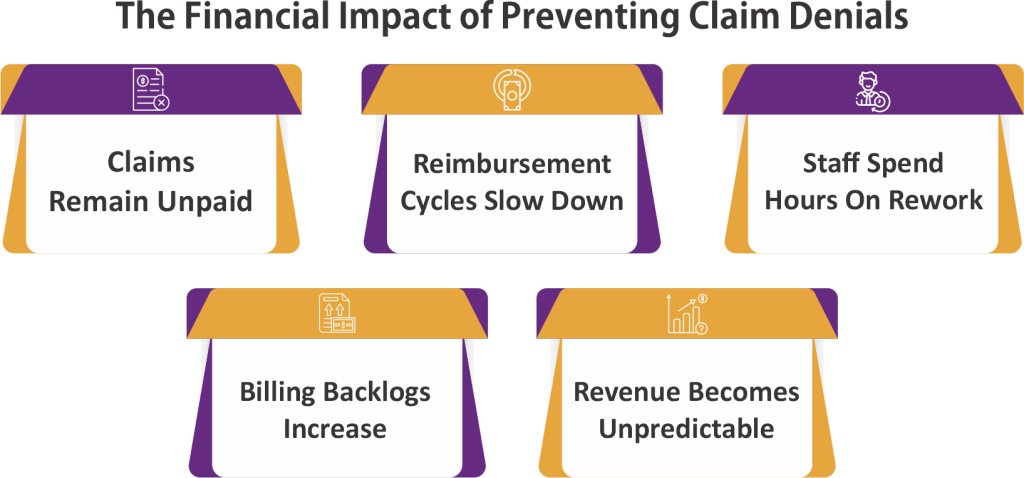
The Financial Impact of Preventing Claim Denials
Reducing claim denials is not just about convenience — it directly protects revenue.
Healthcare organizations lose money when:
- Claims remain unpaid
- Reimbursement cycles slow down
- Staff spend hours on rework
- Billing backlogs increase
- Revenue becomes unpredictable
Industry estimates suggest denied claims can cost providers between $25 and $118 per claim to rework manually.
For practices handling hundreds of claims monthly, those costs escalate rapidly.
Example Scenario
Imagine a clinic submits 2,000 claims per month.
If:
- 8% are denied due to preventable billing errors
- 160 claims require rework
- Each denied claim costs $50 to correct
That practice could lose:
- $8,000 monthly in administrative rework costs alone
- Not including delayed reimbursements or lost claims
AI-powered billing automation helps reduce these preventable losses by improving first-pass claim acceptance rates.
Signs Your Practice May Need AI Medical Billing Support
Many practices do not realize how much revenue leakage exists until billing problems become severe.
Here are some warning signs:
Operational Red Flags
- Rising claim denial rates
- Frequent coding corrections
- Delayed reimbursements
- Increasing accounts receivable
- Staff overtime and burnout
- Manual claim tracking
- Slow payer responses
- Repeated billing errors
Financial Red Flags
- Unpredictable monthly cash flow
- Higher administrative costs
- Revenue collection delays
- Declining profitability
- Increased denial rework expenses
If these issues sound familiar, AI-powered medical billing solutions may significantly improve financial performance.
Why AI Medical Billing Is Becoming Essential for Modern Healthcare
Healthcare billing complexity is increasing every year.
Payer requirements evolve constantly. Coding updates become more detailed. Compliance risks continue growing.
Manual billing processes struggle to keep pace with:
- Complex payer rules
- Prior authorization requirements
- Documentation standards
- Real-time eligibility checks
- Denial management demands
AI helps healthcare organizations scale billing operations without increasing administrative burden at the same rate.
That creates a major competitive advantage.
Practices using AI-assisted revenue cycle management often experience:
- Faster reimbursements
- Better clean claim rates
- Reduced denial rates
- Lower administrative costs
- Improved billing efficiency
- Stronger revenue predictabilit
AI Won’t Eliminate Every Billing Error — But It Can Prevent Most Preventable Ones
This is where realistic expectations matter.
AI cannot completely eliminate all medical billing issues.
Complex payer disputes, unusual documentation scenarios, and evolving regulations still require experienced human oversight.
However, AI can dramatically reduce:
- Repetitive billing mistakes
- Preventable claim denials
- Data-entry errors
- Documentation inconsistencies
- Eligibility-related claim failures
That alone can protect thousands of dollars in monthly revenue for healthcare practices.
Final Thoughts
AI is helping healthcare practices move from reactive billing to proactive revenue protection. By detecting coding issues, eligibility problems, and claim errors before submission, AI-powered medical billing systems can reduce preventable denials and improve cash flow.
However, the best results come from combining intelligent automation with experienced billing professionals. As healthcare billing becomes more complex, practices that adopt AI-assisted revenue cycle management will be better positioned to improve accuracy, reduce administrative burden, and protect long-term profitability.