Healthcare practices lose significant revenue every year due to denied claims, coding errors, delayed reimbursements, and inefficient administrative workflows. As staffing shortages and payer complexities continue to rise, traditional automation is no longer enough to protect financial performance.
Agentic AI is changing that. Unlike conventional AI tools that only provide insights, Agentic AI can autonomously identify revenue leaks, correct billing issues, streamline claims processing, and optimize the entire revenue cycle in real time.
For hospitals, clinics, and medical groups looking to improve cash flow while reducing operational burden, Agentic AI is quickly becoming a competitive advantage rather than just another technology investment.
What Is Agentic AI in Healthcare?
Agentic AI is an advanced form of artificial intelligence that can make decisions, take actions, and complete multi-step tasks with minimal human intervention. In healthcare, it goes beyond simple automation by actively managing workflows across billing, claims processing, coding, denial management, and revenue cycle operations.
Unlike traditional AI systems that only analyze data or generate recommendations, Agentic AI can independently execute tasks such as identifying missing patient information, correcting coding errors, resubmitting denied claims, and prioritizing high-risk accounts receivable cases. This allows healthcare practices to reduce manual workload while accelerating reimbursements and improving financial performance.
As healthcare organizations face increasing administrative complexity and staffing shortages, Agentic AI is becoming a critical solution for building faster, smarter, and more efficient revenue operations.
Traditional AI vs Agentic AI in Revenue Cycle Management
Many healthcare organizations already use AI-powered tools, but most of these systems are limited to task-based automation. Agentic AI introduces a more intelligent and autonomous approach to revenue cycle management.
| Traditional AI | Agentic AI |
| Provides recommendations | Takes autonomous actions |
| Works within fixed rules | Adapts to changing scenarios |
| Handles isolated tasks | Manages end-to-end workflows |
| Requires frequent human input | Operates with minimal supervision |
| Reactive processing | Predictive and proactive execution |
For example, a traditional AI system may identify a claim error, while Agentic AI can detect the issue, correct the data, validate payer requirements, and resubmit the claim automatically. This level of automation significantly improves operational efficiency and reduces revenue leakage.
Revenue Leakage in Healthcare Practices
Revenue leakage occurs when healthcare providers lose income due to billing inefficiencies, denied claims, coding mistakes, delayed submissions, or incomplete documentation. Even small administrative errors can lead to substantial financial losses over time.
Some of the most common causes of revenue leakage include:
- Incorrect patient eligibility verification
- Missing or inaccurate medical codes
- Denied or underpaid insurance claims
- Inefficient prior authorization processes
- Delayed claim submissions
- Poor accounts receivable follow-up
- Documentation gaps in EHR systems
These issues not only impact profitability but also create operational bottlenecks that increase staff burnout and slow reimbursement cycles. For many healthcare practices, recovering lost revenue has become just as important as generating new patient volume.
Agentic AI helps solve these challenges by continuously monitoring workflows, identifying financial risks in real time, and automating corrective actions before revenue is lost.
How Agentic AI Helps Healthcare Practices Recover Lost Revenue
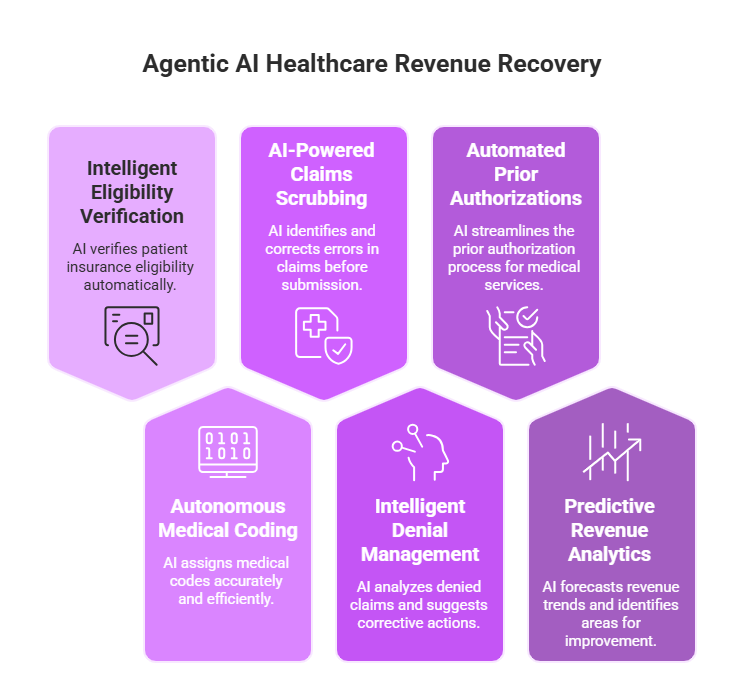
Agentic AI improves healthcare revenue recovery by automating critical processes across the entire revenue cycle. Instead of relying on disconnected systems and manual intervention, healthcare organizations can use autonomous AI agents to optimize workflows from patient intake to final reimbursement.
1. Intelligent Eligibility Verification
Agentic AI verifies insurance eligibility and benefits in real time before appointments are scheduled or claims are submitted. This reduces registration errors and prevents avoidable claim denials caused by incorrect coverage information.
2. Autonomous Medical Coding
AI agents can analyze clinical documentation, identify coding gaps, and recommend accurate CPT and ICD codes. This reduces undercoding, overcoding, and compliance risks while improving reimbursement accuracy.
3. AI-Powered Claims Scrubbing
Before submission, Agentic AI reviews claims against payer-specific rules to identify missing information, billing inconsistencies, and formatting issues. This improves clean claim rates and accelerates payment cycles.
4. Intelligent Denial Management
Denied claims are one of the biggest sources of lost revenue in healthcare. Agentic AI can detect denial patterns, identify root causes, generate appeals, and automate resubmissions, helping practices recover revenue faster.
5. Automated Prior Authorizations
Manual prior authorization workflows consume significant administrative time and often delay patient care. Agentic AI streamlines authorization requests, tracks approvals, and reduces processing delays.
6. Predictive Revenue Analytics
Agentic AI continuously analyzes financial and operational data to identify high-risk claims, forecast reimbursement delays, and uncover hidden revenue opportunities. This allows healthcare leaders to make proactive financial decisions rather than reacting to problems after revenue is lost.
Key Benefits of Agentic AI for Healthcare Practices
Healthcare organizations are under constant pressure to improve financial performance while managing rising operational costs. Agentic AI helps practices achieve both by reducing inefficiencies and accelerating revenue recovery across the revenue cycle.
Reduced Claim Denials: Agentic AI identifies billing errors, missing documentation, and payer-specific compliance issues before claims are submitted. This improves clean claim rates and reduces costly denials that delay reimbursements.
Faster Reimbursements: By automating claims processing, eligibility verification, and accounts receivable follow-ups, healthcare providers can shorten reimbursement cycles and improve cash flow consistency.
Lower Administrative Costs: Manual revenue cycle tasks consume a significant amount of staff time. Agentic AI reduces repetitive administrative work, allowing healthcare teams to focus on higher-value responsibilities and patient care.
Improved Revenue Visibility: AI-driven analytics provide real-time insights into revenue performance, denial trends, reimbursement delays, and operational bottlenecks. This helps leadership teams make faster and more informed financial decisions.
Better Staff Productivity: Billing and RCM teams often struggle with burnout caused by repetitive manual workflows. Agentic AI supports staff by automating time-consuming tasks while improving operational efficiency.
Scalable Financial Operations: As healthcare organizations grow, managing larger claim volumes becomes increasingly difficult. Agentic AI enables practices to scale revenue operations without significantly increasing staffing costs.
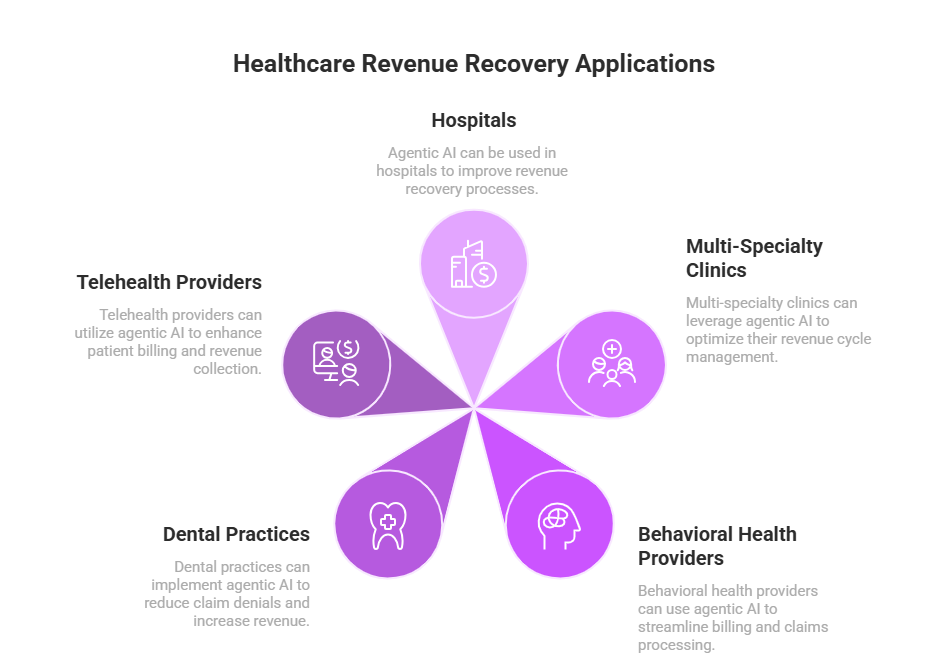
Applications of Agentic AI in Healthcare Revenue Recovery
Healthcare providers across multiple specialties are already using Agentic AI to improve operational efficiency and recover lost revenue.
1. Hospitals
Large hospitals use Agentic AI to manage high claim volumes, automate denial resolution, and optimize payer communication. This reduces reimbursement delays and improves overall revenue performance.
2. Multi-Specialty Clinics
Multi-location practices often struggle with inconsistent billing workflows and coding errors. Agentic AI standardizes revenue cycle operations across departments while reducing administrative overhead.
3. Behavioral Health Providers
Behavioral health organizations frequently face reimbursement challenges due to complex documentation requirements. Agentic AI helps ensure coding accuracy and improves claims approval rates.
4. Dental Practices
Dental clinics use AI-powered billing automation to reduce missed claims, improve insurance verification, and accelerate payment collections.
5. Telehealth Providers
Telehealth organizations rely on Agentic AI to handle rapidly changing payer policies, automate virtual care billing workflows, and reduce claim rejection rates.
These real-world applications demonstrate how Agentic AI is becoming an essential part of modern healthcare revenue cycle management.
Challenges of Implementing Agentic AI in Healthcare
While Agentic AI offers significant financial and operational benefits, successful implementation requires careful planning and governance.
Data Privacy and HIPAA Compliance
Healthcare organizations must ensure AI systems comply with HIPAA and other healthcare data protection regulations. Secure data handling and strong access controls are critical.
Integration With Existing Systems
Many healthcare practices still rely on legacy EHR and billing systems that may not easily integrate with advanced AI platforms. Smooth interoperability is essential for successful deployment.
Human Oversight
Although Agentic AI can automate many workflows, human oversight remains important for handling complex cases, reviewing sensitive decisions, and maintaining compliance standards.
Staff Adoption Challenges
Employees may initially resist AI adoption due to concerns about workflow disruption or job replacement. Clear communication and proper training are essential for improving adoption rates.
AI Accuracy and Governance
Healthcare organizations must continuously monitor AI performance to reduce errors, maintain transparency, and ensure reliable decision-making across financial workflows.
Despite these challenges, organizations that implement Agentic AI strategically can achieve substantial long-term revenue and operational gains.
The Future of Agentic AI in Healthcare Revenue Cycle Management
The healthcare industry is moving toward highly autonomous revenue cycle operations powered by intelligent AI agents. As technology continues to evolve, Agentic AI will become more proactive, predictive, and interconnected across healthcare systems.
Future advancements are expected to include:
- Fully autonomous claims management
- Predictive denial prevention
- AI-driven payer negotiations
- Self-optimizing billing workflows
- Real-time reimbursement forecasting
- Multi-agent collaboration across healthcare departments
Healthcare providers that adopt Agentic AI early will be better positioned to reduce revenue leakage, improve operational resilience, and remain financially competitive in an increasingly complex healthcare environment.
Rather than replacing healthcare professionals, Agentic AI will enhance human capabilities by handling repetitive administrative work and enabling teams to focus on strategic decision-making and patient-centered care.
The Bottom Line
Healthcare practices can no longer afford to lose revenue through inefficient billing processes, claim denials, coding errors, and administrative bottlenecks. As financial pressures continue to grow, traditional automation tools are struggling to keep pace with the complexity of modern healthcare revenue cycle management.
Agentic AI offers a smarter and more proactive solution. By autonomously managing workflows, identifying revenue leaks, optimizing claims processing, and improving reimbursement accuracy, it enables healthcare organizations to recover lost revenue while reducing operational strain.
From intelligent denial management to predictive revenue analytics, Agentic AI is transforming how healthcare providers manage financial operations. Organizations that adopt this technology early will gain a significant advantage through faster reimbursements, lower administrative costs, improved staff productivity, and stronger financial stability.
FAQs
Q: How does Agentic AI reduce claim denials?
Ans: Agentic AI reduces claim denials by identifying billing errors, missing documentation, coding inaccuracies, and payer-specific compliance issues before claims are submitted. It can also automate denial analysis, appeals, and resubmissions.
Q: Can Agentic AI improve healthcare cash flow?
Ans: Yes. By accelerating reimbursements, reducing denied claims, and improving billing accuracy, Agentic AI helps healthcare practices improve cash flow and recover lost revenue faster.
Q: Is Agentic AI HIPAA compliant?
Ans: Agentic AI platforms can be HIPAA compliant when implemented with secure infrastructure, encrypted data handling, access controls, and healthcare compliance standards. Organizations should always choose vendors with strong healthcare security certifications.
Q: Does Agentic AI replace medical billing teams?
Ans: No. Agentic AI is designed to support healthcare staff, not replace them entirely. It automates repetitive administrative tasks, so billing teams can focus on higher-value financial and operational responsibilities.
Q: What healthcare organizations benefit most from Agentic AI?
Ans: Hospitals, multi-specialty clinics, behavioral health providers, dental practices, and telehealth organizations can all benefit from Agentic AI, especially those handling high claim volumes and complex reimbursement workflows.
Q: How long does Agentic AI implementation take?
Ans: Implementation timelines vary depending on system complexity, integration requirements, and organizational size. Many healthcare practices begin seeing operational improvements within a few months of deployment.