
Medical billing and coding sit at the heart of healthcare revenue, yet they’ve long been slowed down by manual work, costly errors, and delayed reimbursements. A single coding mistake can lead to claim denials, compliance risks, or lost income, issues that frustrate providers and patients alike.
This is where artificial intelligence is changing the game. By automating repetitive tasks, detecting errors in real time, and accelerating claims processing, AI is helping healthcare organizations operate smarter, faster, and more accurately.
In this article, you’ll discover how AI is reshaping medical billing and coding, the real benefits it brings, and what it means for the future of healthcare administration.
What is Medical Billing and Coding?
Medical billing and coding are the backbone of the healthcare revenue cycle. They ensure that healthcare providers are properly reimbursed for the services they deliver. While the two terms are often used together, they serve different but closely connected roles.
Medical coding involves translating patient diagnoses, procedures, and treatments into standardized codes such as ICD-10 and CPT. These codes act as a universal language that insurance companies understand.
Medical billing takes those codes and uses them to create and submit claims to insurance providers. Once submitted, the billing process follows the claim through approval, denial, or reimbursement.
The typical workflow starts when a patient receives care. The medical record is reviewed and coded, then a claim is generated and sent to the insurance company. If everything is accurate, payment is processed. If not, the claim may be denied or delayed.
Accuracy is critical at every step. Even small errors can lead to rejected claims, compliance issues, or revenue loss. This is why improving precision and efficiency in this process has become a major priority for healthcare organizations.
What is AI in Healthcare Administration?
Artificial intelligence in healthcare administration refers to the use of advanced technologies that can learn, analyze data, and make decisions with minimal human intervention. In the context of billing and coding, AI focuses on automating tasks that were traditionally done manually.
AI systems use technologies like machine learning and natural language processing to understand medical records, identify patterns, and generate accurate outputs. For example, AI can read clinical notes and automatically assign the correct billing codes based on the information provided.
These systems are often integrated into existing healthcare software such as electronic health records and revenue cycle management platforms. This allows them to work in real time without disrupting existing workflows.
The goal of AI in this space is not just automation but smarter decision-making. It helps reduce human error, improves efficiency, and allows healthcare professionals to focus on more critical tasks rather than repetitive administrative work.
How AI is Transforming Medical Billing and Coding
1. Automated Coding with AI
AI-powered tools can analyze clinical documentation and assign accurate medical codes within seconds. This reduces the need for manual coding and significantly speeds up the entire process. It also helps maintain consistency across records, which is essential for compliance.
2. Error Detection and Reduction
One of the biggest challenges in medical billing is human error. AI systems can identify inconsistencies, missing information, and incorrect codes before claims are submitted. This proactive approach reduces claim denials and improves overall accuracy.
3. Faster Claims Processing
AI streamlines the claims submission process by automating repetitive steps and reducing bottlenecks. Claims that once took days to process can now move through the system much faster, leading to quicker reimbursements for healthcare providers.
4. Fraud Detection and Compliance
AI can analyze large volumes of data to detect unusual patterns that may indicate fraud or non-compliance. It also helps ensure that billing practices follow regulatory requirements, reducing the risk of penalties and audits.
Together, these advancements are reshaping how healthcare organizations handle billing and coding, making the process more efficient, reliable, and scalable.

Key Benefits of AI in Medical Billing
AI is reshaping medical billing by making processes faster, smarter, and more reliable. It reduces inefficiencies that have traditionally slowed down revenue cycles and helps healthcare providers operate with greater confidence and control.
Higher Accuracy in Coding and Billing
AI minimizes human errors by automatically assigning correct codes and validating claims before submission. This leads to fewer denials and resubmissions.
Faster Claims Processing
Automation speeds up the entire billing cycle, from code generation to claim submission, resulting in quicker reimbursements.
Reduced Operational Costs
By cutting down manual work, AI lowers staffing costs and reduces the need for repeated corrections and audits.
Improved Revenue Cycle Management
AI helps track claims in real time, identify bottlenecks, and optimize the entire revenue cycle for better financial outcomes.
Enhanced Compliance and Audit Readiness
AI ensures that billing practices follow regulatory standards, reducing the risk of penalties and compliance issues.
Better Patient Experience
Accurate and timely billing reduces confusion, disputes, and delays, leading to higher patient satisfaction.
Challenges and Limitations of AI
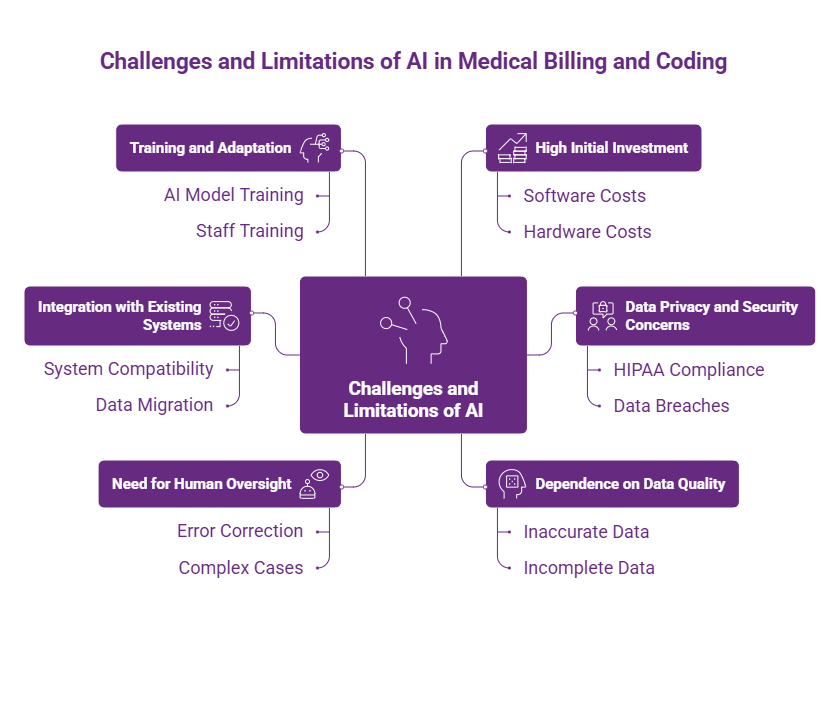
While AI offers significant advantages, it also comes with certain challenges that healthcare organizations must carefully manage to fully benefit from its capabilities.
High Initial Investment: Implementing AI systems can be costly, especially for small and mid-sized healthcare providers.
Data Privacy and Security Concerns: Handling sensitive patient data requires strict compliance with privacy regulations and strong cybersecurity measures.
Dependence on Data Quality: AI systems rely on accurate and well-structured data. Poor data quality can lead to incorrect outputs and inefficiencies.
Need for Human Oversight: AI cannot fully replace human expertise. Professionals are still required to review complex cases and ensure accuracy.
Integration with Existing Systems: Many healthcare organizations use outdated software that may not easily integrate with modern AI solutions.
Training and Adaptation: Staff need proper training to effectively use AI tools, which can take time and resources.
AI vs Traditional Medical Billing
The shift from traditional to AI-powered medical billing highlights a clear transformation in efficiency, accuracy, and scalability. While traditional methods rely heavily on manual effort, AI introduces automation and intelligence that streamline the entire process.
| Feature | Traditional Medical Billing | AI-Powered Medical Billing |
| Processing Speed | Slow and time-consuming | Fast and automated |
| Accuracy | Prone to human error | High accuracy with validation |
| Cost Efficiency | Higher labor costs | Reduced operational costs |
| Error Rate | Frequent mistakes and rework | Minimal errors with AI checks |
| Scalability | Limited by workforce capacity | Easily scalable with automation |
| Compliance | Manual compliance tracking | Automated compliance monitoring |
| Claims Approval Rate | Lower due to errors | Higher due to improved accuracy |
Real-World Use Cases of AI in Medical Billing and Coding
AI is not just a concept; it is already being used across healthcare systems to solve real billing and coding challenges. From small clinics to large hospitals, organizations are leveraging AI to improve efficiency and financial performance.
Automated Medical Coding in Hospitals
Hospitals use AI tools to scan clinical documentation and automatically assign accurate ICD and CPT codes. This reduces turnaround time and ensures consistency across large volumes of patient records.
Insurance Claims Processing
Insurance companies use AI to review claims, verify information, and approve or flag them within seconds. This speeds up the approval process and reduces manual review workload.
Denial Management and Prevention
AI systems analyze past claim data to identify patterns that lead to denials. They then suggest corrections before submission, increasing first pass claim acceptance rates.
Revenue Cycle Management Optimization
Healthcare providers use AI to monitor the entire revenue cycle, from patient registration to final payment. It helps identify delays, predict cash flow, and improve overall financial performance.
Fraud Detection Systems
AI tools analyze billing patterns and detect unusual activities that may indicate fraud or misuse. This helps organizations stay compliant and avoid financial losses.
Future of AI in Medical Billing and Coding
The future of AI in medical billing and coding is moving toward smarter, more connected, and highly automated systems that go beyond basic task execution. AI will increasingly use predictive analytics to anticipate claim outcomes, identify potential errors before submission, and optimize revenue cycles in real time.
As integration with electronic health records and other healthcare platforms improves, billing processes will become more seamless and less dependent on manual input. At the same time, AI will enhance transparency for patients by providing clearer and more personalized billing information.
Rather than replacing professionals, AI will continue to support them, allowing billing and coding experts to focus on complex decisions, compliance, and quality assurance while routine tasks are handled efficiently by intelligent systems.
Conclusion
AI is transforming medical billing and coding by making processes faster, more accurate, and more efficient. It reduces errors, accelerates reimbursements, and helps healthcare organizations manage their revenue cycles with greater precision. While there are challenges such as cost and integration, the long-term benefits make AI a powerful tool for modern healthcare systems. As adoption continues to grow, those who embrace AI early will be better positioned to improve financial performance and deliver a smoother experience for both providers and patients.
FAQs
Q: Can AI replace medical coders?
Ans: AI can automate many coding tasks, but human expertise is still essential for handling complex cases, reviewing outputs, and ensuring compliance.
Q: Is AI in medical billing secure?
Ans: Yes, when implemented correctly, AI systems follow strict data protection protocols and comply with healthcare regulations to keep patient information safe.
Q: How accurate is AI in medical coding?
Ans: AI is often more accurate than manual processes because it reduces human error and continuously learns from data patterns.
Q: What skills are needed to work with AI in billing?
Ans: Professionals need a mix of medical billing knowledge and basic technical skills, including understanding AI tools, data validation, and system monitoring.