
Medical credentialing and provider enrollment have long been among the most complex and time-intensive processes in healthcare administration. From verifying licenses and certifications to enrolling providers with multiple insurance payers, every step demands precision, compliance, and constant follow-ups.
Yet, despite their importance, these processes are often slowed down by manual paperwork, data entry errors, and fragmented systems, leading to delayed approvals and lost revenue opportunities. Artificial Intelligence (AI) is changing that reality. By automating repetitive tasks, intelligently verifying data, and streamlining workflows, AI is helping healthcare organizations move faster, reduce costly errors, and stay compliant with evolving regulations.
Instead of weeks or months, credentialing and enrollment can now be completed in a fraction of the time, with greater accuracy and transparency.
What is Medical Credentialing and Enrollment?
Medical credentialing is the process of verifying a healthcare provider’s qualifications, including education, training, licenses, certifications, and work history. It ensures that providers meet the required standards before they are allowed to practice.
In simple terms, credentialing answers one critical question: Is this provider qualified and trustworthy to deliver care?
Key components of credentialing include:
- Verification of medical licenses and board certifications
- Review of education and training history
- Work experience validation
- Background checks and malpractice history
- Ongoing monitoring of credentials
What is Enrollment in Healthcare?
Provider enrollment is the process of registering healthcare professionals with insurance companies and government payers so they can bill for services and receive payments.
While credentialing focuses on verifying qualifications, enrollment focuses on financial and operational authorization.
Key elements of provider enrollment include:
- Submitting applications to insurance payers
- Completing payer-specific documentation
- Linking providers to healthcare organizations
- Setting up billing and reimbursement details
- Maintaining updated enrollment records
Why These Processes Matter
Credentialing and enrollment are not just administrative tasks. They are critical to the overall functioning of healthcare systems.
They play a vital role in:
- Patient safety: Ensures only qualified providers deliver care
- Regulatory compliance: Meets standards set by healthcare authorities and payers
- Revenue cycle management: Prevents claim denials and payment delays
- Operational efficiency: Enables smooth onboarding of new providers
Without proper credentialing and enrollment, healthcare organizations risk compliance violations, financial losses, and reputational damage.
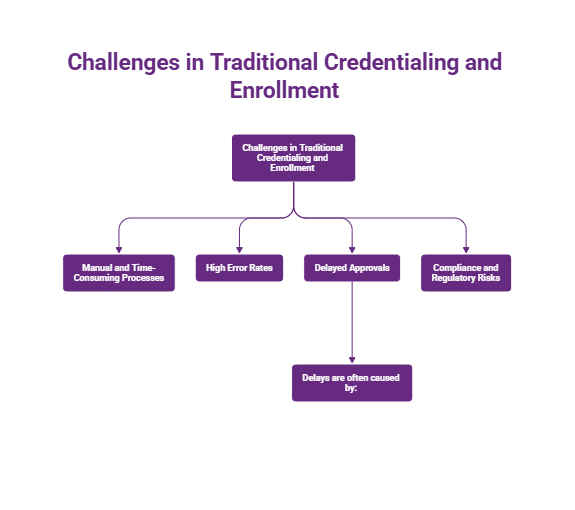
Challenges in Traditional Credentialing and Enrollment
Despite their importance, traditional credentialing and enrollment processes are often slow, fragmented, and prone to inefficiencies. Many healthcare organizations still rely heavily on manual workflows, which creates bottlenecks and increases the likelihood of errors.
Manual and Time-Consuming Processes: Traditional systems depend on paperwork, spreadsheets, and manual data entry, which significantly slows down the process.
Common issues include:
- Repetitive form filling across multiple systems
- Dependence on emails, faxes, and physical documents
- Lack of centralized data management
This often results in credentialing timelines stretching from weeks to several months.
High Error Rates: Manual data entry increases the risk of mistakes, which can lead to application rejections and delays.
Typical errors include:
- Incorrect provider information
- Missing documentation
- Inconsistent data across forms
Even small inaccuracies can disrupt the entire process and require rework.
Delayed Approvals: Credentialing and enrollment delays directly impact provider onboarding and revenue generation.
Delays are often caused by:
- Slow verification from primary sources
- Back-and-forth communication with payers
- Incomplete or incorrect submissions
As a result, providers may be unable to see patients or bill for services on time.
Compliance and Regulatory Risks: Healthcare regulations frequently change, and keeping up with them manually is challenging.
Key risks include:
- Failure to meet payer-specific requirements
- Expired licenses or certifications going unnoticed
- Inadequate audit trails
Non-compliance can lead to penalties, denied claims, and legal complications.
What is AI in Healthcare Administration?
Artificial Intelligence in healthcare administration refers to the use of advanced technologies that can analyze data, automate tasks, and make intelligent decisions with minimal human intervention. In the context of credentialing and enrollment, AI helps eliminate repetitive manual work while improving accuracy and speed.
In simple terms, AI acts like a digital assistant that not only performs tasks but also learns and improves over time.
AI in healthcare operations involves systems that can process large volumes of data, recognize patterns, and support decision-making. These systems are designed to handle administrative complexities that would otherwise require significant human effort.
Core capabilities of AI include:
- Understanding and processing structured and unstructured data
- Automating repetitive workflows
- Identifying patterns and anomalies
- Supporting real-time decision-making
This makes AI especially valuable in processes like credentialing, where accuracy and compliance are critical.
Types of AI Used
Different types of AI technologies work together to streamline credentialing and enrollment processes. Each plays a specific role in improving efficiency and reducing manual workload.
1. Robotic Process Automation (RPA)
A half-line explanation: Handles repetitive, rule-based tasks automatically.
- Automates data entry and form submissions
- Transfers data between systems
- Reduces human intervention in routine workflows
2. Natural Language Processing (NLP)
A half-line explanation: Enables machines to understand and interpret human language.
- Extracts data from documents like resumes and licenses
- Reads and categorizes unstructured text
- Improves document handling efficiency
3. Predictive Analytics
A half-line explanation: Uses historical data to predict outcomes and trends.
- Identifies potential delays in credentialing
- Flags high-risk applications
- Helps in proactive decision-making
Together, these technologies create a smarter and more efficient administrative ecosystem that reduces bottlenecks and improves overall workflow performance.
How AI is Transforming Medical Credentialing?
AI is fundamentally changing how medical credentialing is performed by introducing automation, intelligence, and real-time monitoring into what was once a slow and manual process. It reduces turnaround times while improving accuracy and compliance.
Automated Data Extraction and Verification
A half-line explanation: AI captures and verifies data without manual input.
AI-powered systems can scan documents, extract relevant information, and verify it against trusted databases in seconds.
Key advantages include:
- Eliminates manual data entry
- Reduces human errors
- Speeds up verification processes
- Ensures data consistency across systems
This significantly shortens the time required to complete credential checks.
Real-Time License Monitoring
A half-line explanation: Continuous tracking of provider credentials.
AI systems can monitor licenses and certifications in real time, ensuring that all credentials remain valid and up to date.
Benefits include:
- Instant alerts for expiring licenses
- Continuous compliance monitoring
- Reduced risk of regulatory violations
This proactive approach replaces periodic manual checks with continuous oversight.
Intelligent Document Processing
A half-line explanation: AI understands and organizes complex documents.
Using NLP, AI can read, interpret, and categorize large volumes of documents quickly and accurately.
What it enables:
- Automatic classification of documents
- Faster document review
- Reduced administrative workload
- Improved document accuracy
This removes the need for manual sorting and reviewing of paperwork.
Fraud Detection and Risk Reduction
A half-line explanation: AI identifies inconsistencies and potential risks.
AI can analyze patterns and detect anomalies that may indicate fraudulent or incorrect information.
Key capabilities include:
- Cross-checking data across multiple sources
- Identifying mismatched or suspicious records
- Reducing the risk of credential fraud
By adding an extra layer of intelligence, AI helps maintain trust and integrity in the credentialing process.
How AI Improves Provider Enrollment
AI is significantly enhancing provider enrollment by streamlining complex workflows, reducing administrative burden, and improving submission accuracy. What once required constant follow-ups and manual coordination can now be handled through intelligent automation.
Faster Application Processing: A half-line explanation: AI accelerates the entire enrollment lifecycle. AI systems can automatically fill out forms, validate data, and submit applications to multiple payers simultaneously.
Key improvements include:
- Reduced processing time from weeks to days
- Automated population of payer-specific forms
- Faster communication between systems and stakeholders
This allows providers to start seeing patients and generating revenue much sooner.
Reduced Rejections and Errors: A half-line explanation: AI ensures accuracy before submission. AI validates data in real time and checks for missing or incorrect information before applications are submitted.
Benefits include:
- Fewer application rejections
- Improved first-pass acceptance rates
- Consistent and accurate data across submissions
This minimizes costly delays caused by rework and corrections.
Payer-Specific Requirement Matching: A half-line explanation: AI adapts to different payer rules automatically. Each insurance payer has unique requirements, and AI systems can be trained to recognize and apply these variations.
What this enables:
- Customized application handling for each payer
- Automated compliance with payer guidelines
- Reduced manual research and guesswork
This ensures that applications meet all requirements the first time.
Workflow Automation: A half-line explanation: End-to-end automation of enrollment processes. AI integrates with existing systems to manage the entire enrollment workflow from start to finish.
Core capabilities include:
- Task assignment and tracking
- Automated status updates
- Seamless coordination between teams
- Centralized data management
This creates a more organized and efficient enrollment process with minimal manual intervention.
Key Benefits of AI in Credentialing and Enrollment
AI is not just improving processes but delivering measurable benefits that directly impact operational efficiency, cost savings, and overall performance in healthcare organizations.
Speed and Efficiency
A half-line explanation: Faster processes with minimal delays.
AI reduces the time required for credentialing and enrollment by automating repetitive tasks and eliminating bottlenecks.
Results include:
- Shorter onboarding timelines
- Faster approvals and verifications
- Increased productivity across teams
Cost Reduction
A half-line explanation: Lower operational expenses through automation.
By reducing manual work and minimizing errors, AI helps organizations cut down on administrative costs.
Cost-saving factors include:
- Reduced labor requirements
- Fewer rework cycles
- Lower compliance-related penalties
Improved Accuracy
A half-line explanation: Higher precision in data handling.
AI ensures that data is consistent, complete, and error-free across all stages of the process.
Accuracy benefits include:
- Elimination of manual entry mistakes
- Standardized data across systems
- Reliable documentation and reporting
Better Compliance
A half-line explanation: Continuous adherence to regulations.
AI systems are designed to stay updated with regulatory requirements and ensure compliance at every step.
Compliance advantages include:
- Automated tracking of credential expirations
- Built-in regulatory checks
- Detailed audit trails for inspections
Scalability for Healthcare Organizations
A half-line explanation: Easily handles growing workloads.
AI allows organizations to scale operations without significantly increasing staff or resources.
Scalability benefits include:
- Ability to manage high volumes of applications
- Consistent performance during peak periods
- Flexibility to adapt to organizational growth
Real-World Use Cases of AI in Credentialing
AI is already being adopted across different segments of the healthcare industry, delivering measurable improvements in credentialing and enrollment workflows. These real-world applications highlight how organizations are leveraging AI to solve long-standing inefficiencies.
Hospitals and Health Systems
A half-line explanation: Large-scale automation for complex provider networks.
Hospitals manage hundreds or even thousands of providers, making credentialing a massive operational task. AI helps streamline and centralize these processes.
Common use cases include:
- Automated primary source verification of provider credentials
- Real-time tracking of license expirations
- Centralized credentialing dashboards for better visibility
- Faster onboarding of new physicians and specialists
This enables hospitals to maintain compliance while improving operational efficiency.
Medical Billing Companies
A half-line explanation: Faster enrollment to accelerate revenue cycles.
Medical billing companies rely heavily on timely provider enrollment to ensure claims can be processed without delays.
Key applications include:
- Automated payer enrollment submissions
- AI-driven error detection before claim filing
- Integration with billing systems for seamless workflows
- Reduced claim denials due to enrollment issues
This directly impacts revenue by minimizing delays and improving claim acceptance rates.
Telehealth Providers
A half-line explanation: Rapid credentialing across multiple locations.
Telehealth platforms often require providers to be credentialed in multiple states or regions, which can be complex and time-consuming.
How AI helps:
- Multi-state license verification and tracking
- Automated compliance with regional regulations
- Faster onboarding of remote healthcare providers
- Scalable systems to support rapid growth
This allows telehealth companies to expand services quickly without administrative bottlenecks.
AI vs Traditional Credentialing
To understand the true impact of AI, it is important to compare it with traditional credentialing methods. The differences clearly show how AI enhances efficiency, accuracy, and scalability.
| Feature | Traditional Credentialing | AI-Powered Credentialing |
| Speed | Slow and manual | Fast and automated |
| Accuracy | Prone to errors | Highly accurate |
| Cost | High operational costs | Reduced costs |
| Compliance | Reactive approach | Proactive and continuous |
| Scalability | Limited capacity | Easily scalable |
A half-line explanation: AI transforms credentialing from reactive to proactive.
Traditional systems rely heavily on human effort, which increases the chances of delays and mistakes. In contrast, AI-powered systems automate workflows, validate data in real time, and continuously monitor compliance.
Challenges of Implementing AI in Credentialing
While AI offers significant advantages, implementing it comes with its own set of challenges. Understanding these barriers helps organizations prepare and adopt AI more effectively.
Data Privacy Concerns: A half-line explanation: Protecting sensitive healthcare data is critical. Healthcare data is highly sensitive, and AI systems must comply with strict privacy regulations.
Key concerns include:
- Secure handling of patient and provider data
- Compliance with data protection laws
- Risk of data breaches if systems are not properly secured
Organizations must ensure strong cybersecurity measures are in place.
Integration with Legacy Systems: A half-line explanation: Compatibility with existing infrastructure can be complex. Many healthcare organizations still use outdated systems that may not easily integrate with AI technologies.
Common challenges include:
- Data silos across different platforms
- Lack of standardized data formats
- High effort required for system upgrades
Proper planning and phased implementation can help overcome these issues.
Initial Setup Costs: A half-line explanation: Upfront investment can be significant. Implementing AI requires investment in technology, infrastructure, and expertise.
Cost factors include:
- Software and licensing fees
- System integration expenses
- Ongoing maintenance and updates
However, these costs are often offset by long-term savings and efficiency gains.
Staff Training Requirements: A half-line explanation: Teams need to adapt to new technologies. Adopting AI requires staff to learn new tools and workflows.
Training needs include:
- Understanding AI-driven systems
- Managing automated workflows
- Interpreting AI-generated insights
With proper training, teams can transition smoothly and maximize the benefits of AI.

Future Trends: AI in Healthcare Credentialing
AI is continuously evolving, and its role in credentialing and enrollment is expected to become even more advanced. Future developments will focus on making these processes more predictive, secure, and fully automated.
Predictive Credentialing
A half-line explanation: AI anticipates issues before they occur.
Instead of reacting to expired licenses or missing documents, AI will use historical data to predict and prevent delays.
What this means for organizations:
- Early alerts for upcoming credential expirations
- Identification of potential application bottlenecks
- Proactive workload management
- Reduced last-minute compliance risks
This shift from reactive to predictive processes will significantly improve efficiency.
Blockchain and AI Integration
A half-line explanation: Secure and tamper-proof credential storage.
Combining AI with blockchain technology can create a decentralized and highly secure system for storing and verifying credentials.
Key advantages include:
- Immutable records of provider credentials
- Faster verification across organizations
- Reduced risk of fraud or data manipulation
- Improved trust between providers, payers, and institutions
This integration has the potential to eliminate repetitive verification processes.
Fully Autonomous Enrollment Systems
A half-line explanation: End-to-end automation with minimal human involvement.
Future AI systems will be capable of handling the entire enrollment lifecycle independently.
Capabilities may include:
- Automatic data collection and validation
- Intelligent decision-making for approvals
- Real-time communication with payers
- Continuous updates and compliance tracking
This will allow organizations to operate with greater speed and minimal administrative burden.
How to Implement AI in Credentialing
Adopting AI in credentialing and enrollment requires a strategic approach to ensure successful integration and long-term value. Organizations need to align technology with their existing workflows and goals.
Assess Current Workflow
A half-line explanation: Understand existing inefficiencies before внед implementing AI.
Begin by evaluating current credentialing and enrollment processes to identify bottlenecks and gaps.
Focus areas include:
- Time taken for each process step
- Common sources of errors
- Manual tasks that can be automated
- Existing system limitations
This helps in defining clear objectives for AI adoption.
Choose AI Tools or Vendors
A half-line explanation: Select solutions that match organizational needs.
Not all AI tools are the same, so choosing the right vendor is critical.
Consider the following factors:
- Compatibility with existing systems
- Features tailored to credentialing and enrollment
- Scalability and customization options
- Vendor support and industry experience
A well-chosen solution ensures smoother implementation.
Integrate with Existing Systems
A half-line explanation: Ensure seamless data flow across platforms.
Integration is essential to avoid disruptions and maintain consistency.
Key steps include:
- Connecting AI tools with current software systems
- Migrating and standardizing data
- Eliminating data silos
- Testing system interoperability
Proper integration enhances overall efficiency.
Train Staff
A half-line explanation: Equip teams with the skills to use AI effectively.
Employees need to understand how to work alongside AI systems.
Training should cover:
- Using AI-powered tools and dashboards
- Managing automated workflows
- Interpreting AI insights and reports
- Adapting to new processes
Well-trained staff can maximize the value of AI implementation.
Monitor and Optimize
A half-line explanation: Continuously improve system performance.
AI systems require ongoing monitoring to ensure optimal results.
Optimization strategies include:
- Tracking performance metrics
- Identifying areas for improvement
- Updating systems based on feedback
- Scaling operations as needed
Continuous improvement ensures long-term success.
Summary
AI is reshaping medical credentialing and enrollment by addressing long-standing inefficiencies and introducing a new level of speed, accuracy, and reliability. By automating repetitive tasks, reducing errors, and ensuring continuous compliance, AI enables healthcare organizations to operate more effectively and deliver better outcomes.
Organizations that embrace AI can streamline provider onboarding, minimize delays, and improve revenue cycles while maintaining high standards of compliance. As technology continues to evolve, the role of AI in credentialing and enrollment will only become more significant, making early adoption a strategic advantage.
Now is the time for healthcare providers, billing companies, and administrators to evaluate their current processes and explore how AI can transform their operations for long-term success.