

In today’s healthcare environment, even small billing inefficiencies can create major financial losses. Yet many clinics, private practices, and healthcare organizations still rely on manual medical billing processes that quietly drain revenue every single month.
From claim denials and coding inaccuracies to staff burnout and reimbursement delays, manual billing systems are becoming one of the biggest hidden threats to healthcare profitability.
What once worked for smaller practices is no longer sustainable in a healthcare landscape driven by complex payer rules, HIPAA compliance requirements, and rising administrative demands.
The reality is simple: manual medical billing is no longer just inefficient — it’s expensive.
The Hidden Costs of Manual Medical Billing
Many healthcare providers assume manual billing saves money because they avoid investing in advanced medical billing software or outsourced medical billing services.
But the true cost of manual processes often goes unnoticed.
Every manually entered claim increases the risk of:
- Human error
- Coding inaccuracies
- Missing patient information
- Duplicate entries
- Delayed reimbursements
- Rejected insurance claims
Even a small increase in claim denial rates can create substantial revenue leakage over time.
For example, a healthcare practice processing 1,500 claims monthly with a preventable denial rate of just 7% could lose between $18,000 and $45,000 per month in delayed or unrecovered payments.
That loss compounds rapidly over a year.
And unlike obvious operational expenses, these losses often remain hidden inside slow revenue cycle management workflows.
Why Medical Billing Errors Hurt Revenue Cycle Management
Manual medical billing places enormous pressure on billing staff to handle repetitive administrative tasks with perfect accuracy.
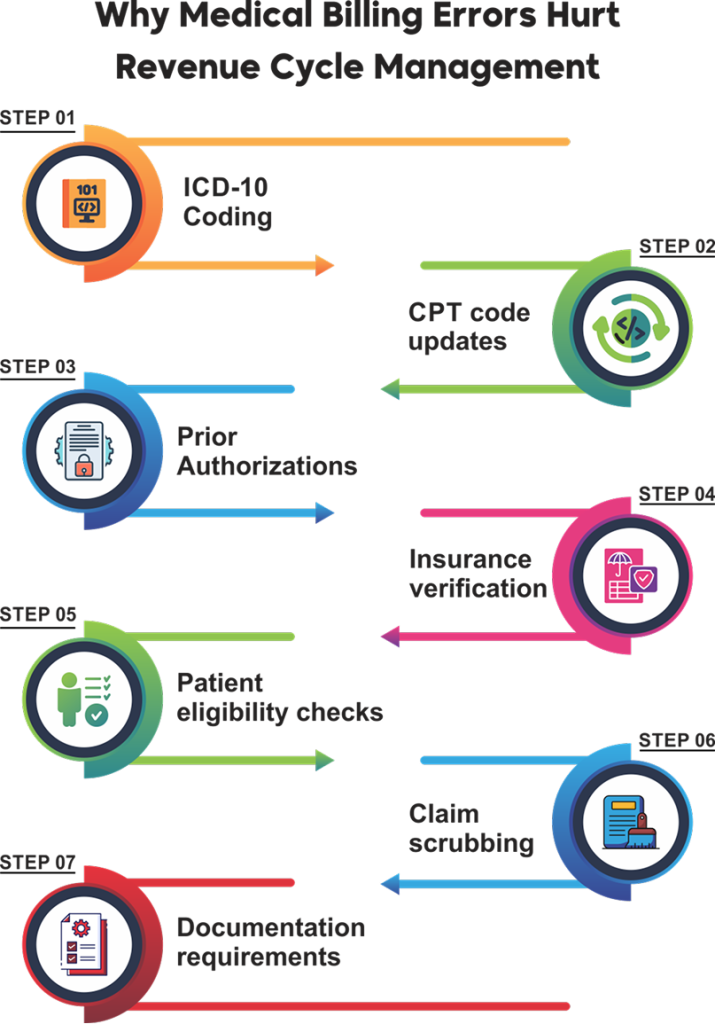
Unfortunately, even experienced teams make mistakes when dealing with:
- ICD-10 coding
- CPT code updates
- Prior authorizations
- Insurance verification
- Patient eligibility checks
- Claim scrubbing
- Documentation requirements
As payer regulations continue to evolve, manually tracking changes becomes increasingly difficult.
This leads to:
- Higher claim denial rates
- Increased accounts receivable (A/R)
- Slower cash flow
- Administrative bottlenecks
- More time spent on rework and appeals
Modern healthcare practices cannot afford these inefficiencies.
Revenue cycle management depends on speed, accuracy, and automation — areas where manual systems consistently fall behind.
The Financial Impact of Claim Denials
One of the biggest problems with manual billing is the rising cost of denied claims.
When claims are submitted with coding errors, incomplete documentation, or incorrect patient data, insurance companies reject or delay payments.
Each denied claim creates additional administrative work:
- Identifying the error
- Correcting the claim
- Resubmitting documentation
- Following up with payers
- Waiting for reimbursement again
This process wastes valuable staff hours while slowing healthcare cash flow.
According to industry trends, healthcare organizations are experiencing increasing denial rates due to growing payer complexity and changing compliance requirements.
The worst part?
Many denied claims are never recovered at all.
That means healthcare practices are losing revenue for services they already provided.
Staff Burnout Is Becoming a Serious Billing Problem
Most competitors focus only on software or outsourcing benefits.
What they fail to address is the operational strain manual billing places on internal teams.
Manual billing workflows often force employees to:
- Work overtime
- Manage repetitive data entry
- Handle constant payer follow-ups
- Process appeals manually
- Monitor changing insurance policies
- Resolve billing backlogs
Over time, this creates:
- Billing staff burnout
- Higher employee turnover
- Increased training costs
- Lower productivity
- Greater error rates
When experienced billing staff leave, practices lose institutional knowledge and face even more disruptions to reimbursement workflows.
The hidden labor cost of manual medical billing is often far greater than healthcare providers realize.
Manual Medical Billing vs Automated Revenue Cycle Management
Healthcare organizations that adopt healthcare billing automation and outsourced medical billing services gain a major competitive advantage.
Here’s the difference:
| Manual Medical Billing | Automated Revenue Cycle Management |
| Higher denial rates | Improved clean claim rate |
| Slow claim submission | Faster reimbursement cycles |
| Human-dependent accuracy | AI-assisted validation |
| Administrative overload | Streamlined workflows |
| Delayed payment processing | Real-time claim tracking |
| High operational costs | Reduced billing overhead |
| Staff burnout risk | Scalable billing operations |
| Compliance vulnerabilities | Automated compliance checks |
Automation allows healthcare providers to focus on patient care instead of administrative chaos.
Why Small Billing Mistakes Become Massive Revenue Losses
Many practices underestimate how quickly small inefficiencies escalate financially.
For example:
- A claim delayed by 30 days impacts monthly cash flow
- Repeated coding errors increase payer scrutiny
- Slow collections hurt operational stability
- Manual follow-ups consume valuable staff time
- Billing backlogs delay reimbursements across the entire practice
Even minor inefficiencies create a ripple effect throughout the revenue cycle.
Over time, manual medical billing contributes to:
- Revenue leakage
- Lower physician profitability
- Poor patient billing experiences
- Increased administrative costs
- Reduced operational scalability
Healthcare practices that continue relying on outdated billing methods risk falling behind competitors using AI-driven revenue cycle management solutions.
How AI and Automation Improve Medical Billing Efficiency
Modern medical billing software and AI-powered billing systems dramatically reduce common billing problems.
Automation improves:
- Claim scrubbing accuracy
- Eligibility verification
- Coding consistency
- Electronic claim submission
- Denial management
- Payment tracking
- Reporting and analytics
AI-assisted systems can detect billing issues before claims are submitted, helping practices achieve cleaner claims and faster reimbursements.
This reduces:
- Rejected claims
- Administrative workload
- Billing delays
- Compliance risks
It also allows billing teams to focus on higher-value tasks instead of repetitive manual processes.
Signs Your Practice Has Outgrown Manual Billing
Many healthcare organizations don’t realize they’ve already outgrown manual billing workflows.
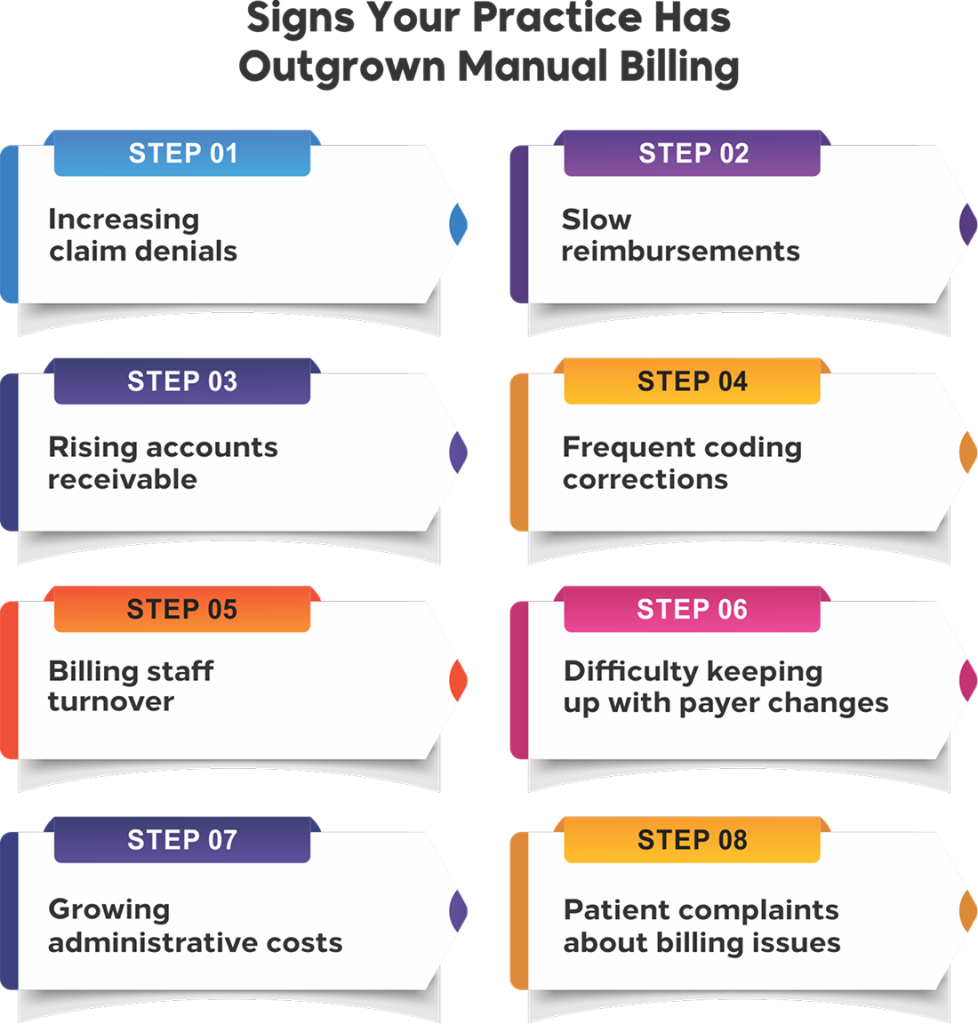
Common warning signs include:
- Increasing claim denials
- Slow reimbursements
- Rising accounts receivable
- Frequent coding corrections
- Billing staff turnover
- Difficulty keeping up with payer changes
- Growing administrative costs
- Patient complaints about billing issues
If these problems sound familiar, your practice may already be losing significant monthly revenue due to inefficient billing operations.
Why More Practices Are Outsourcing Medical Billing Services
Healthcare providers are increasingly turning to outsourced medical billing services because outsourcing offers:
- Lower operational costs
- Access to specialized billing experts
- Improved claim accuracy
- Faster reimbursements
- Better denial management
- Scalable revenue cycle support
- Reduced compliance risk
- Greater financial visibility
Outsourcing also eliminates the burden of managing large in-house billing teams while improving overall healthcare financial performance.
For growing practices, outsourcing is often more cost-effective than maintaining inefficient manual systems internally.
The Future of Medical Billing Is Automated
Healthcare billing complexity will continue increasing.
Insurance regulations, coding updates, compliance requirements, and payer policies are evolving faster than manual workflows can realistically handle.
Practices that continue relying on outdated billing methods risk:
- Higher denial rates
- Revenue loss
- Slower growth
- Staff burnout
- Reduced profitability
The future belongs to healthcare organizations that embrace:
- AI medical billing
- Revenue cycle automation
- Data-driven billing analytics
- Intelligent denial prevention
- Scalable outsourced billing solutions
Modernizing your billing operations is no longer optional — it’s essential for long-term financial stability.
Final Thoughts
Manual medical billing may appear manageable on the surface, but the hidden financial impact can be devastating for healthcare practices.
From reimbursement delays and claim denials to staff burnout and revenue leakage, outdated billing processes quietly cost providers thousands every month.
Healthcare organizations that invest in automation, optimized revenue cycle management, and outsourced medical billing services position themselves for:
- Faster reimbursements
- Reduced operational costs
- Improved clean claim rates
- Better compliance
- Stronger long-term profitability
The question is no longer whether practices should modernize their billing systems.
The real question is:
How much revenue is your practice already losing by staying manual?